Thanks Guys,
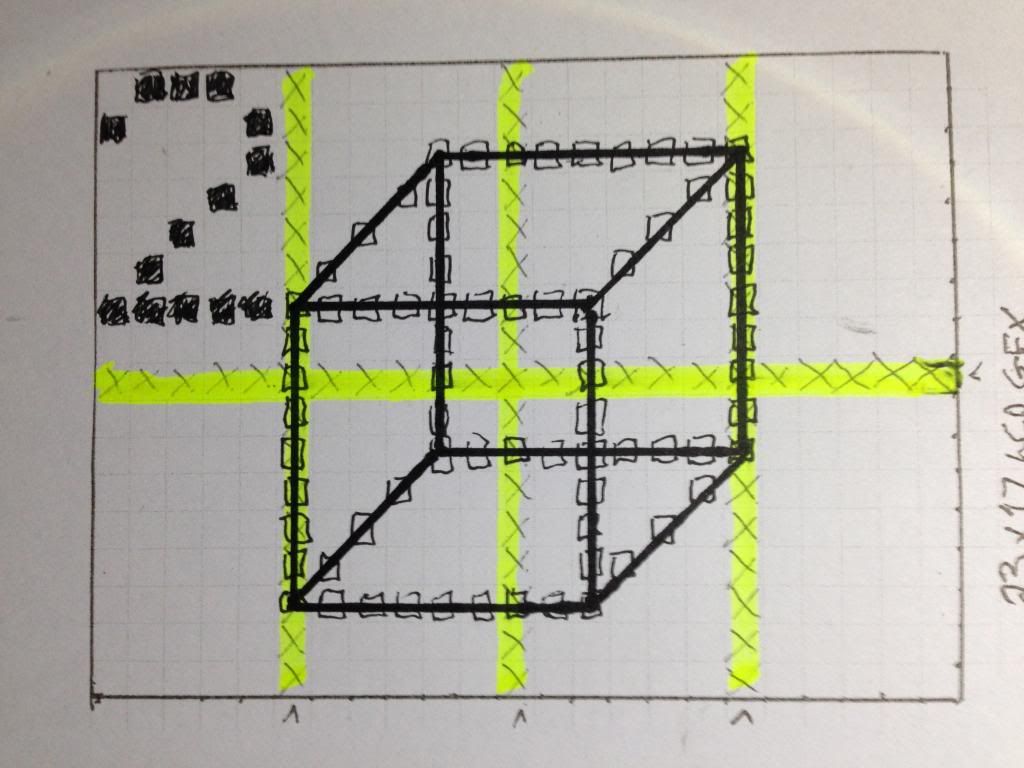
I am having some trouble with diagonal lines and circles.
When you use a real gfx display with PBP, is it usually the display that
handles the lines and circles, or is it done in PBP?
I'm finding the algorithms are usually in C, and all seem to want to look
for values below zero (signed integer variables), where one of these
variables would wrap back to 0xFF if you decremented from zero using PBP
For the only diagonal lines in the video, I was able to do a trick and
check a value is above #128, pretending that value is zero.
This is so far only working if the destination point of the line has higher
x and y coordinates than the start point..
(ie. I can draw a line at any angle from x-0,y-0, to anywhere).
Here is the difference in the code.
Code:
x0 = 3 : y0 = 3
x1 = 21 : y1 = 11
gosub drawline
Code:
drawline:
	stepx = 0
	stepy = 0
	frac = 0
	'a line is x0,y0 to x1,y1.
	dy = y1 - y0
	dx = x1 - x0

	IF dy > 128 THEN
	dy = dy - 1
	stepy = stepy - 1
	ELSE
	stepy = 1
	ENDIF

	IF dx > 128 THEN
	dx = dx - 1
	stepx = stepx - 1
	ELSE
	stepx = 1
	ENDIF

	dy = dy << 1
	dx = dx << 1

    'draw pixel
	px = x0 : py = y0
	gosub setpixel

	IF (dx > dy || dx > 128) THEN

    frac = dy - (dx >> 1)
    WHILE x0 != x1
    IF (frac < 128) THEN
	y0 = y0 + stepy
 	frac = frac - dx
	ENDIF
    x0 = x0 + stepx
    frac = frac + dy
    'draw pixel
  	px = x0 : py = y0
	gosub setpixel
    WEND

	ELSE

    frac = dx - (dy >> 1)
    WHILE y0 != y1
    IF (frac < 128) THEN
	x0 = x0 + stepx
	frac = frac - dy
	ENDIF
    y0 = y0 + stepy
    frac = frac + dx
    'draw pixel
	px = x0 : py = y0
	gosub setpixel
    WEND

	ENDIF

return
... and the original C
Code:
static void drawLine(int x0, int y0, int x1, int y1, int color, Color* destination, int width)
{
	int dy = y1 - y0;
	int dx = x1 - x0;
	int stepx, stepy;

	if (dy < 0) { dy = -dy;  stepy = -width; } else { stepy = width; }
	if (dx < 0) { dx = -dx;  stepx = -1; } else { stepx = 1; }
	dy <<= 1;
	dx <<= 1;

	y0 *= width;
	y1 *= width;
	destination[x0+y0] = color;
	if (dx > dy) {
		int fraction = dy - (dx >> 1);
		while (x0 != x1) {
			if (fraction >= 0) {
				y0 += stepy;
				fraction -= dx;
			}
			x0 += stepx;
			fraction += dy;
			destination[x0+y0] = color;
		}
	} else {
		int fraction = dx - (dy >> 1);
		while (y0 != y1) {
			if (fraction >= 0) {
				x0 += stepx;
				fraction -= dy;
			}
			y0 += stepy;
			fraction += dx;
			destination[x0+y0] = color;
		}
	}
}
I wonder what of the C compilers that are for 16F pics.
Maybe they don't do signed integers either?
If I could compile the original C source in a pic C compiler,
and then disassemble it, I could have the result in RISC asm.



 2x16 LCD Graphics :)




 Originally Posted by Art









Bookmarks