Hi, Flotul,
Those BMS are not always installed ...
I have dozens of LiPo / LiFe batts home and only one has it included ... so, consider it's not mandatory !!!
sometimes, there's only a fuse !!!
Alain
Hi, Flotul,
Those BMS are not always installed ...
I have dozens of LiPo / LiFe batts home and only one has it included ... so, consider it's not mandatory !!!
sometimes, there's only a fuse !!!
Alain
************************************************** ***********************
Why insist on using 32 Bits when you're not even able to deal with the first 8 ones ??? ehhhhhh ...
************************************************** ***********************
IF there is the word "Problem" in your question ...
certainly the answer is " RTFM " or " RTFDataSheet " !!!
*****************************************

my experience to date is that the bms is far more likely to fail before the battery and that it will then do its best to destroy the battery utterly.
i have had good success in removing failed bms modules to discover perfectly good batteries . better bms modules are cheap and plentiful.
just because they won't take a charge is not always a dead battery
Last edited by richard; - 2nd June 2020 at 12:43.
Warning I'm not a teacher
I agree with this.
When we order batts, there is option having it with the protection; As it is an option and if you have a smart charging circuit, then it just additional cost which I think is unnecessary.
The ones with the protectioın we received have higher failure return rate than those without the protection. Circuit burns out eventhough there is nothing wrong with the charging.
"If the Earth were a single state, Istanbul would be its capital." Napoleon Bonaparte
Lithium batts should be under surveillance either charging or discharging.
The little circuits are supposed to work in either case, not allowing overcharge or flat discharge the batteries. The second is important as many devices continue to drain the batteries to very low levels, finally destroying them.
It is really annoying that the protection circuits fail...
Ioannis
Hi All,
I'm now (finally...) building my project and its about time to order the missing components to have something to play with (without any reference to naughty thoughts).
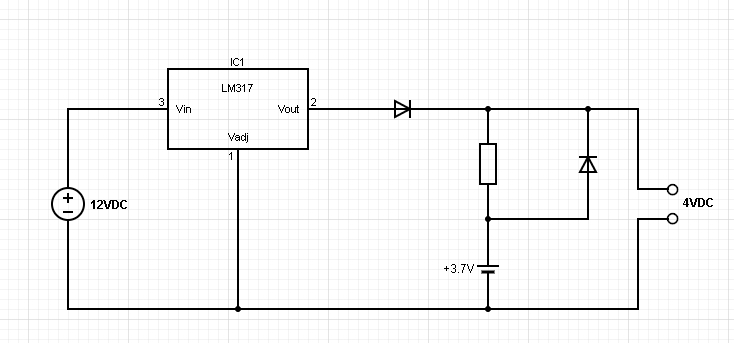
So, here's the circuit I'm building:
Reading the (very interesting) MicroChip's AN1149 about battery charge and power backup, I can see that a particular attention is to be paid to the choice of the Q1's (the P-Mosfet) where a "proper" Vgs(th) has to be chosen.
Unfortunately, I'm not an electronician, just an electrician creating himself (lots of) problems with this PIC stuff = I don't know how to calculate or determine with exactitude how to dimension the needed P-chanel Mosfet
Can anyone help me out and suggest a component (according to the DS, a combined S-diode and Mosfet is nice) or the Vgs(th) value I will have to find to make my circuit work? Instead, I would appreciate someone explain me how to "calculate" this Vgs(th) I'll need....
Roger
BTW, I don't think the above schema will work.
Is this really correct?
Shouldn't it be something more like this?
![]()
Last edited by flotulopex; - 11th February 2021 at 15:37.
Roger
First schematic can work. But MOSFET have no purpose. There is no need for one.
Second schematic doesn't allow battery discharge when charging.
Don't know where you found that schematic, but look at
http://ww1.microchip.com/downloads/e...tes/01149c.pdf
Page 2.
Thanks pedja,
The schemas come from this exact document you refer to in your last post, adapted to DC supply.
Can you please explain?But MOSFET have no purpose. There is no need for one.
Without any "switch" (MOSFET in this cas, how I understand it), how would hte load be fed either by the main supply or the battery in case of main supply failure?
Roger
Bookmarks