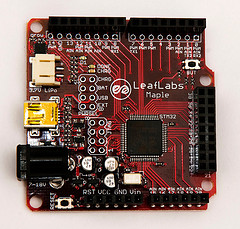
I have not tried it as I no longer work with MCHP MCUs. I did take a look at this one as it uses an ST32 processor http://leaflabs.com/devices/maple/
![]()
I have not tried it as I no longer work with MCHP MCUs. I did take a look at this one as it uses an ST32 processor http://leaflabs.com/devices/maple/
![]()
Why pay for overpriced toys when you can have
professional grade tools for FREE!!!
Right now it looks like the ds30 bootloader will work with the 16F88 so I may end up with a nifty little, super economical development system for prototyping, testing PIC code and prototyping, testing shields. I'll be able to say a bit more once I get the XINO kit. There's a dearth of online documentation so all is possible until I get the hardware and documentation and reality sets in.
For working with the EM500/GA1000 (if the long-promised firmware is ever released) we only need a serial link and a reset line with very simple code since all the heavy lifting takes place in the EM500 (which requires coding in Tibbo's Basic dialect).
I think I can do a similar simple shield for the ConnectOne Socket LanReach and mini iWiFi modules (one only plugged in at a time).
Oh, one change to the layout. I've doubled the pads around the perimeter so a scope or logic probe can access pins which are not used on the shield but may be employed in the PIC program being developed for a more permanent design.
The STM32 includes a dedicated USB peripheral which can be configured to act as a generic USB slave device with transfer rates up to 12Mbps. It is configured for two uses: first, to receive sketch/program uploads from the IDE and secondly, to emulate a regular serial port for use as a terminal (text read/write). For more info, see http://leaflabs.com/docs/usb.html and http://leaflabs.com/docs/lang/api/se...lang-serialusb
Why pay for overpriced toys when you can have
professional grade tools for FREE!!!
For my own use, in keeping with the philosophy of phrugality behind the XINO Basic board, I'd like to use a 16F88 with internal 8MHz OSC and with the two comparators used as inverters for the serial lines. There are, at least, three possible bootloaders - TinyPIC Bootloader, Spark Fun's BLoader & ds30. The latter is probably required for those using the bigger PIC but I think the others use less space on the 16F88.
However, I still need a power supply. So it might be better to use an external USB-Serial adapter which can also supply power. This frees the comparators for other uses and saves the cost of an external power supply. An external 5V power supply actually costs less than the USB-Serial adapter but the adapter has the advantage that there are virtual serial port drivers for Windows, Linux & OSX. Plus, using the comparators requires revising the bootloader code which may be above my paygrade. I'll have to wait until I have the XINO kit and USB-Serial adapter in hand to see how best to interface them. While waiting for them (as well as the release of the long-promised Tibbo EM500/GA1000 firmware), I'll do a shield layout for ConnectOne ethernet modules.
The people who make the XINO also have a prototyping shield called ProtoX which you can see on this page (scroll down). This should be compatible with Arduino and clones like Amicus18.
Bookmarks