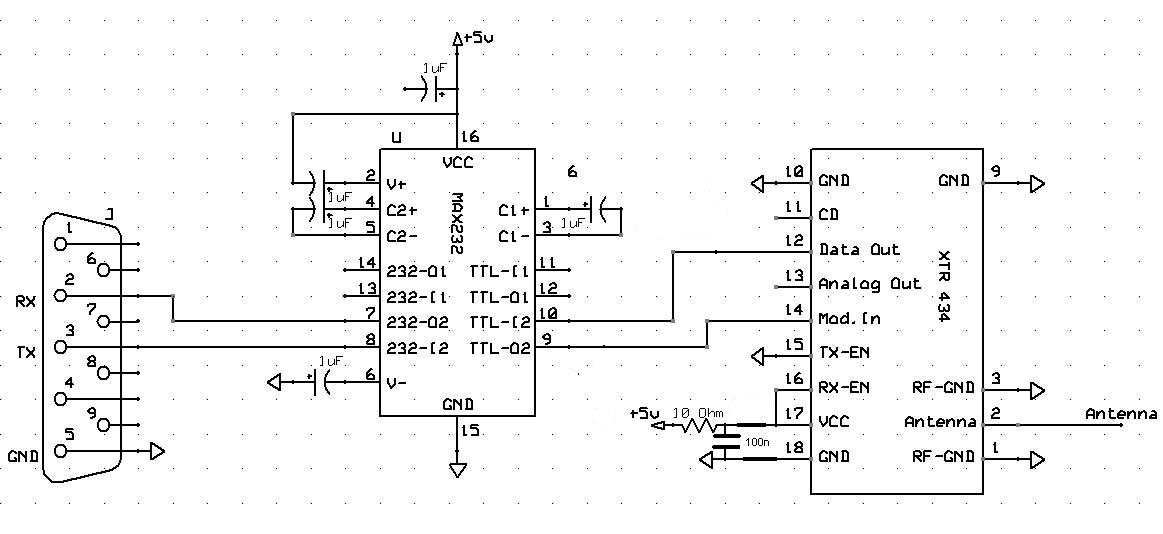
XTR-434 transceiver


Closed Thread
Results 1 to 17 of 17

Hybrid View

  1. #1
    Join Date
    Jun 2008
    Posts
    4


    Did you find this post helpful? Yes | No

    Default

    10x for the reply man bt i have already downloaded the user manual and the datasheet from the aurel site and they tell u how to relay each pin and i have done this but still the output on pin 12 is 2.45 and the say in the datasheet that it is supposed to be 0 or 5V
    so that is my prob..
    thank u again

  2. #2
    Join Date
    Nov 2003
    Location
    Greece
    Posts
    4,170


    Did you find this post helpful? Yes | No

    Default

    From the data sheets I see that your load on pin 12 should be more than 100K. At 10K load the output is 3.5 volts.

    What are you driving with pin 12?

    Ioannis

  3. #3
    Join Date
    Dec 2005
    Posts
    1,073


    Did you find this post helpful? Yes | No

    Default

    Quote Originally Posted by Toufic View Post
    10x for the reply man bt i have already downloaded the user manual and the datasheet from the aurel site and they tell u how to relay each pin and i have done this but still the output on pin 12 is 2.45 and the say in the datasheet that it is supposed to be 0 or 5V
    so that is my prob..
    thank u again
    Are you reading the manual correctly? The manual indicates there will be random noise whenever the RX is enabled. You must use the CD pin to determine whether it is signal or noise. The manual also indicates that you need to use manchester coding as the dataslicer is designed for a 50% duty cycle (and will not function if the duty cycle deviates too far). This means that you cannot set the transmitter High or Low (steady-state) and expect the RX pin to reflect that. If you send a series of pulses (50% duty cycle), you should see the same at the receiver. The manual specifically notes that you cannot use the module for RS232 data streams without using some scheme to achieve DC balance (e.g. manchester coding). All in all, this is not a module for the inexperienced.

  4. #4
    Join Date
    Jun 2008
    Posts
    4


    Did you find this post helpful? Yes | No

    Default

    hey 10x for ur reply
    but let me ask u something if i am using his transceiver as receiver all the time unless i am sending data and the data input for the transmitter is from the USART of pic16f877a i am using a baud rate of 9.6kbps but if i changed the rate to 56.7kbps would it work...
    i am not familiar with this manchester coding thing so that is why i skipped this part..
    thanks again

  5. #5
    Join Date
    Dec 2005
    Posts
    1,073


    Did you find this post helpful? Yes | No

    Default

    Page 3 of the manual says...
    • Bit ON/Bit OFF relation: the Data Slicer is optimized for a 50:50 duty cycle. It will continue to operate,
      even with bigger distortion and less tolerance to interferences, till a 30:70 or 70:30 duty-cycle.
      Therefore there is no possibility to directly transmit an RS232 sequence if no action is done to balance the 1
      and 0 bits ratio, as the duty-cycle could reach up to 90% preventing the proper performance of receiver. It
      will continue to operate, even with bigger distortion and less tolerance to interferences, till a 30:70 or 70:30
      duty cycle.
    • XTR-434
      While modulation is applied to TX, conditioning input pin [pin 14] with a logic signal, it is reccomended not
      to exceed 200 μs continuous time with no transition from ON to OFF or OFF to ON. This not to downgrade
      the RX sensitivity. It is requested that modultation is carried on with techniques that allow a low duty-cycle,
      such as Manchester coding, 8 to 12 bit coding or other available technique. If no bit balancing technique is
      used, if it is requested to work with RS232 protocol, a minimum speed of 57.600 bps is required to assure
      maximum performance, transmitting, for example, one byte followed by the complementary byte (byte
      balancing).
    The Data Slicer is a comparator with a capacitor on one input. The data goes to both inputs but the capacitor charges to an average of the data. When the data is higher than the average level, the output is high and when the data is lower than the average level, the output is low. The higher baud rate allows less time for the capacitor to discharge which may explain why it appears to work at higher rates but you should not count on this being reliable unless you use byte balancing and rates of 57.600 bps or higher.

    Follow the manufacturer's recommendation and use manchester coding (or byte balancing) or find another transceiver. You can find thousands of web pages that describe manchester coding and a search of the forums will turn up Melanie's example code.

    Byte balancing means you send each byte twice - once normally but followed immediately by its bitwise complement (i.e. each 1 becomes 0 and vice versa). The sequence is Byte1 ~Byte1 Byte2 ~Byte2...ByteN ~ByteN. On the receiving end, each pair must sum to $FF. If not, there was an error in transmission or reception.

    You can see some oscilloscope screenshots showing the effects of the data slicer here...
    Last edited by dhouston; - 28th June 2008 at 12:22.

  6. #6
    Join Date
    Nov 2003
    Location
    Greece
    Posts
    4,170


    Did you find this post helpful? Yes | No

    Default Mancester encoding

    What Dave is trying to tell you is that you cannot raise the transmit line to 1 and expect that at the receivers output you will get a steady 1 for long time. This is NOT possible with the XTR module. It is possible with other tranceivers that are capable of direct RS-232 transmission.

    RF is very different than direct cable link.

    As for Manchester do a search and you shall find. Alot of infos. With 2 words works like this:

    to send 1 0 0 0 0 0 0 1 the PIC should send the 1 0 0 1 0 1 0 1 0 1 0 1 0 1 0 1 1 0, that is the 1 is translated to 1 0 and the 0 to 0 1. So even if you send a steady 1 or 0 the XTR wil get a changing 1 0 or 0 1 at the input, cancelling out the DC component that a steady 1 or 0 carries.

    Hope it makes some sense now.


    Ioannis

  7. #7
    Join Date
    Jun 2008
    Posts
    4


    Did you find this post helpful? Yes | No

    Default

    thank you guys...
    i think now i am going to change the transmitter...
    but the problem is that we are a small country here and cann't find all kind of transceivers here..so if u know a transceiver that could work in my situation please send its number to me and i will check it out..
    thank you again

  8. #8
    Join Date
    Nov 2003
    Location
    Greece
    Posts
    4,170


    Did you find this post helpful? Yes | No

    Default

    If the encoding can and it sure can be done in software there is no need to change the tranceiver. It is no difficult to do it. But then, it is up to you...

    Ioannis

Similar Threads

  1. Transceiver ER900TRS Easy Radio
    By Pesticida in forum mel PIC BASIC Pro
    Replies: 3
    Last Post: - 17th August 2008, 12:25
  2. RF Transceiver modules help
    By davewanna in forum mel PIC BASIC Pro
    Replies: 3
    Last Post: - 16th May 2008, 15:54
  3. Tws 434/ Rws 434
    By jmbanales21485 in forum Serial
    Replies: 10
    Last Post: - 29th July 2007, 07:04
  4. 2.4Ghz Transceiver Module (TRW-24G)
    By ngeronikolos in forum mel PIC BASIC Pro
    Replies: 2
    Last Post: - 28th June 2006, 16:16
  5. Aurel XTR 434 transceiver
    By Eng4444 in forum Schematics
    Replies: 0
    Last Post: - 7th May 2006, 23:07

Members who have read this thread : 0

You do not have permission to view the list of names.

Posting Permissions

  • You may not post new threads
  • You may not post replies
  • You may not post attachments
  • You may not edit your posts