PICPROTO 18 Prototyping Board Examples


Closed Thread
Results 1 to 10 of 10

Hybrid View

  1. #1


    Did you find this post helpful? Yes | No

    Default Prototyping techniques

    Here are two shots of a board I built for analysing hemoglobin oxygen absorption in blood. It is built on an Olimex P40 board with SMT resistors & caps on the underside. All the wiring is wire wrap wire soldered directly to underside of the board. There is a 16 bit ADC, Real Time Clock, LCD driver, variable amplitude LED drivers and a PIC16F877A. The Olimex boards are single sided so there is a tendency for pads to fall off after extensive modifications but they are excellent value for money for quick solutions to one-off problems.

    A small Outline SOIC8 pack is on a sub protytype board.

    I started out with the solderless breadboards. They are great while they are new and for prototyping small ideas. They get dust and other crap in the holes giving poor analog connections for 16 bit work. They are also relatively noisy with highish capacitance between pins. They rapidly reach a level of complexity where each new wire disturbs an existing wire and it gets very frustrating working out where any problems are. Full marks for skimask/mister e/whoever that just posted that monster solderless breadboard.

    With prototype PCB services now so affordable, I have made myself three general purpose boards for PIC 40 pin packs. I use EAGLE (paid 100 x 160 mm version) and get these made in Malaysia at CustomPCB for about $10 each in plate through double sided. These have headers for switch inputs, LCD outputs, SOIC 8, SOIC 16 and a reasonable sized prototyping area.


    HTH
    Brian
    Attached Images Attached Images     

  2. #2
    Join Date
    Jul 2003
    Location
    Colorado Springs
    Posts
    4,959


    Did you find this post helpful? Yes | No

    Default

    Wow, you guys scare me.

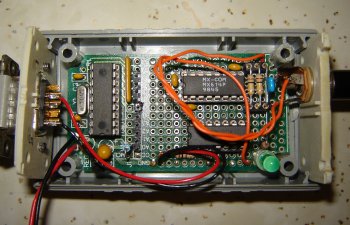
    I imagine the way the other prototypes shown in this thread started, was to take a board, plug in the parts in some manner that visually appealed to the builder, without regard to the circuits flow, then take a bunch of wires to hook up the different connections. Wherever they may be.

    I suppose it's just different ways of doing things, but that's way to many wires for me.

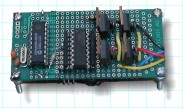
    This board is still a work in progress. But it shows a different way of interconnecting parts.
    I don't even know that I could explain how to do it other than to say, you have to be able to visualize it in your head, before you put it on the board.

    I try to put as many parts as possible, close to the parts they connect to. Minimizing wires (also called antenna) as much as I possibly can. Power busses are run on the top of the board with insulated wires.

    It also keeps my cats from playing with the "antenna".

    <img src="http://www.picbasic.co.uk/forum/attachment.php?attachmentid=2523&stc=1&d=120875099 6" />

    <img src="http://www.picbasic.co.uk/forum/attachment.php?attachmentid=2524&stc=1&d=120875099 6" />

    Ok, obviously not a PICPROTO18, but the ideas could still apply.
    Attached Images Attached Images   
    DT

Similar Threads

  1. Replies: 8
    Last Post: - 7th December 2006, 16:42
  2. PIC16F62x 18 pin SMT breakout PCB
    By jdgrotte in forum Adverts
    Replies: 1
    Last Post: - 1st January 2004, 09:59

Members who have read this thread : 0

You do not have permission to view the list of names.

Posting Permissions

  • You may not post new threads
  • You may not post replies
  • You may not post attachments
  • You may not edit your posts