Hi Andy,
Here is a link for you. It has a Metal Detector circuit with 12F1840.
Also, below is the circuit schematic.
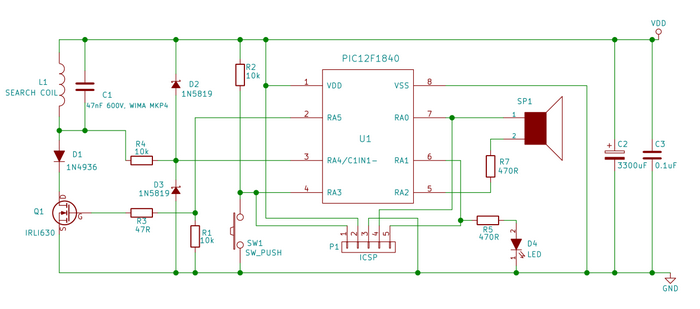
![]()
Hi Andy,
Here is a link for you. It has a Metal Detector circuit with 12F1840.
Also, below is the circuit schematic.
![]()
"If the Earth were a single state, Istanbul would be its capital." Napoleon Bonaparte
Hello
First of all Thank you again for sharing this information with me.
I have taken a look shortly at the details of this design.
On the hand I have checked local markets for this PIC12F1840 ; it is not available at the moment at local shops, and on the other hand this project only has HEX & ASM files as sources for this mentioned micro controller.
Also, I am very interested in to use the DT-Ints (Darrel Taylor Instant Interrupt routines) and use LCD, of course to add a keyboard for the purpose of frequency adjustments, battery level monitoring and other facilities and etc. So I decide to switch to a better PIC chip such as PIC16F877A or some other equal types as well.
For now, it is difficult for me to adapt the ASM file to a program with PicBasicPro language.
Would you please do a great favor to me and just give me some clues that HOW I should use DT-Ints for handling this issue? for the reference of this below schematic.
Many many thanks again for your help and always kindly support forum members.
Regards,
Andy Brown
Hi Andy and welcome back. Sorry for the kick!
About the firmware, I'd recommend to start without DT-INTS, as it is not necessary, at least for the first experiments.
Look at this phrase: "In my design pulses occur at 2 millisecond intervals. Pulse duration is 140 microseconds." This is easy for any PIC to produce.
Start by this and then try to check with analog input for the decay time it takes. Maybe comparator is better choice than ADC as it is much faster.
Ioannis
Bookmarks