


Entire demo is 872 words ,its less than 1/3 size of other attempts and has same features and a full alpha-numeric font


 Nokia lcd include , small footprint to suit pic16's
Entire demo is 872 words ,its less than 1/3 size of other attempts and has same features and a full alpha-numeric font
Warning I'm not a teacher

 |
|
 Re: Nokia lcd include , small footprint to suit pic16's
Amazing work Richard.
5*
Ioannis
|
Re: Nokia lcd include , small footprint to suit pic16's
Well done Richard, Ioannis almost got it right - put a star up against your name and let's call it 6*.
Regards,
Bill
|
Re: Nokia lcd include , small footprint to suit pic16's
I agree... nicely done, Richard. I can't tell you how much I enjoy studying and learning from your code.
I was inspired by how you compressed a 96 character 5x7 font table down to something like 288 words and I spent most of the day implementing something similar on an old 5110 demo program written in C for a 16F1823. With just basic INIT, CMD, DAT, and STR functions, the program now uses less than 500 words of program memory. I'm pretty geeked about it! Thank you...
Take care. Have fun. Cheerful regards, Mike
Last edited by Mike, K8LH; - 18th May 2018 at 09:41.
|
Re: Nokia lcd include , small footprint to suit pic16's
if you really want to geek it up
changing the output routine to use the mssp module shaves another 10% off the code size
and speeds the thing up by a factor of 10x
din and clk need to be on sdo and sck
this
PAUSEUS 150
SHiftOUT LCD_DIN,LCD_CLK,1,[LcdData]
becomes
PIR1.3=0
SSP1BUF = LcdData
WHILE !PIR1.3 : wend
and this is added to init routine
SSP1CON1=$21 ;$22,21,20 all work @32mhz 20 is fastest
SSP1STAT=$40
Last edited by richard; - 18th May 2018 at 09:52.
Warning I'm not a teacher
|
Re: Nokia lcd include , small footprint to suit pic16's
Yes, I already thought about using the SPI module. The current bit-bang driver uses 14 words of memory and runs at ~190-kb/s (with 8-MHz clock). An SPI driver and its init code shouldn't be any bigger. I hope to work on an SPI driver later today. I just need to refresh my memory on the SPI modes. Looks like you're using CKE = 1 and CKP = 0, yes?
Implementing the 'packed' font table and extracting data was surprisingly simple, though I'm coding pretty close to the metal and the results are nothing as agile or elegant as your use of the 'readcode' function. Here's an excerpt, if you're interested;
Code:/******************************************************************** * * ********************************************************************/ void RdFlash() // bank 3 (inserted by compiler) { asm bcf _eecon1,CFGS // not 'config' memory |03 asm bsf _eecon1,EEPGD // select 'program' memory |03 asm bsf _eecon1,RD // initiate read operation |03 asm nop // required nop |03 asm nop // " |03 asm incf _eeadrl,F // bump EEADR |03 asm btfsc _status,Z // " |03 asm incf _eeadrh,F // " |03 asm rlf _eedatl,W // move b7 into Carry |03 asm rlf _eedath,W // wreg = the 7 bit hi byte |03 asm bcf _eedatl,7 // eedatl = the 7 bit lo byte |03 } // /******************************************************************** * * ********************************************************************/ void WrChar(char ascii) // WrChar() for packed 5x7 font { asm movf _ascii,W // ascii char value, 32..127 |00 asm addlw -32 // minus table offset |00 asm movwf _ascii // font array index, 0..95 |00 /* * * multiply index by 3 (0..95 -> 0..285), add table base address, * * and stuff the result in the EEADR register pair. * * */ asm lslf _wreg,W // wreg = (ascii-32)*2 |00 asm addwf _ascii,W // wreg = (ascii-32)*3 |00 // asm movlb 3 // bank 3 (inserted by compiler) |03 asm movwf _eeadrl // flash address lo |03 asm movlw 1024/256 // table address hi |03 asm btfsc _status,C // overflow? no, skip, else |03 asm addlw 1 // bump value |03 asm movwf _eeadrh // flash address hi |03 /* * * read 3 words (6 bytes) of font pattern data from the 5x7 font * * array and write them to the Nokia 5110 LCD. * * */ for(char i=0; i<3; i++) // { RdFlash(); // read one word (2 bytes) putlcd(wreg); // send hi byte putlcd(eedatl); // send lo byte } // } // /******************************************************************** * * ********************************************************************/ void WrChar(rom char *data) // overload function for strings { char ndx = 0; // while(data[ndx++]) // while not end-of-string WrChar(wreg); // } //Thank you again for sharing your work. MikeCode:/* * * initialize Nokia 5110 LCD display * * */ delay_ms(30); // rst = 0; // 5110 'reset' pulse rst = 1; // dc = 0; // command mode putlcd(0x20+0x01); // function set: extended instructions putlcd(0x80+0x30); // set Vop (contrast), 0..127 putlcd(0x04+0x02); // set temperature coefficient, 0..3 putlcd(0x10+0x03); // Set bias system, 0..7 putlcd(0x20+0x00); // function set: standard instructions putlcd(0x08+0x04); // display control: normal mode putlcd(0x80+0x20); // set DDRAM X address, 0..83 putlcd(0x40+0x02); // set DDRAM Y address, 0..5 dc = 1; // data mode WrChar("Hello"); // test string overload function
Last edited by Mike, K8LH; - 18th May 2018 at 15:49. Reason: additional code excerpt
|
Re: Nokia lcd include , small footprint to suit pic16's
Hi Richard,
Just taking a quick look at your Include demo and I can only write 13 characters per line successfully... if 14 then the result is a wrap around and overwriting of the first char. Example below:
I'll test more later today and let you know if I find anything else needing a tweak. Again, great job.Code:looper: LCDCLR ; LCDSTR 6,0,"-Nokia-Demo-" ; Line 0, position 6. LCDSTR 0,0,"I wonder what happens if the string is large?" ; = Rubbish on first line and "missing quote" error message. ; LCDSTR 0,0,"I wonder what?" ; = "? wonder what" [14 chars] LCDSTR 0,0,"I wonder what" ; = "I wonder what" [13 chars only] LCDC 0,4,"'" ; Line 4, position 0. LCDC 25,5,"8" ; Line 5, position 25. PAUSE 1000 GOTO looper
Regards,
Bill
|
Re: Nokia lcd include , small footprint to suit pic16's
yes probably, but here is a new version with double size chr capability and mssp and font unpacking in asm [like in my ks0108 code]
its not been texted on a pic18 , but its blisteringly fast on the 16f1847, and will fill screen fully
thanks go to blll [wjsmarine] for donation of hardware for this project, enjoy
|
Re: Nokia lcd include , small footprint to suit pic16's
That's impressive, Richard.
Can you explain how your font table works and how you derived those values in each column please? What limits the size of the table one can create?
I'd like to learn from it and maybe if I can get my head around the process find a way to smooth out the double size characters (particularly 0-9, the degree symbol and C) - I'm guessing you are working your magic to achieve double size by math so it probably means making a larger table to accommodate these.
An indication of smooth characters is shown in the pic attached, made with the previous lookup table style, which consumed 4 normal sized chars' area per big one and 2 lines (as does yours) and also noting the degree C was formed as one big character. Apologies for the blurry image, not helped with the scratchy plastic over the LCD to protect the glass...
Thanks for your patience and help.
Regards,
Bill
|
Re: Nokia lcd include , small footprint to suit pic16's
I replace the _ chr with @ dw 642 , 9266 ,72 in my fonts to get a deg C chr
correct , I know of no realistic way to smooth the result , it has been tried.achieve double size by math so it probably means making a larger table to accommodate these
table size is only limited by the memory available.
if you create a large font say 14x10 for digits it would not be an unreasonable size, but would need its own routines to unpack and display
if you plot my font on graph paper its pretty obvious how it works, the pic 18 version is easier to disassemble
|
Re: Nokia lcd include , small footprint to suit pic16's
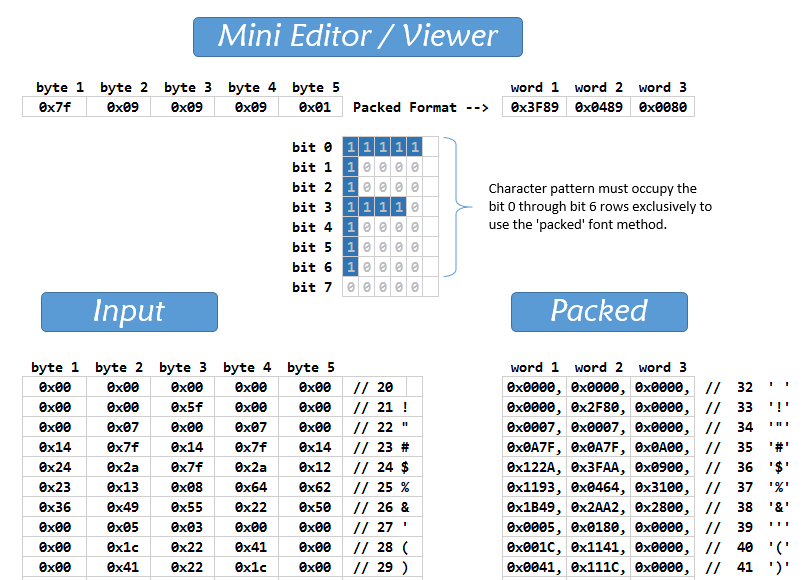
some 8x8 graphpaper
AND an old spread sheet that did the number crunching
Warning I'm not a teacher
|
Re: Nokia lcd include , small footprint to suit pic16's
I used a spreadsheet to convert my old 5 byte per character tables, too. Works a treat...
Cheerful regards, Mike
Last edited by Mike, K8LH; - 19th May 2018 at 21:39.
|
Re: Nokia lcd include , small footprint to suit pic16's
I came up with the same solution , the freely available font creators [like the mikronta one] don't really
convert the font to the most efficient format for pic's when codespace is an issue.
although they can be a good starting point
Warning I'm not a teacher
|
Re: Nokia lcd include , small footprint to suit pic16's
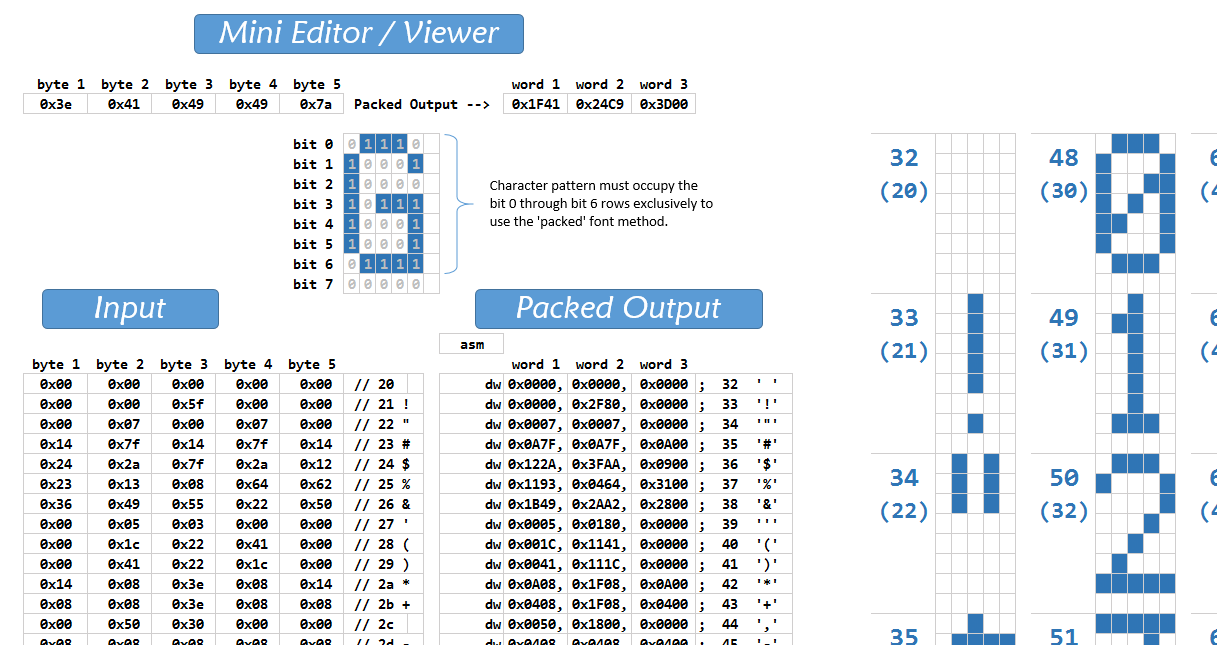
Nice job on the spreadsheet, Richard. I just finished modifying mine to format the packed font table output for either C or asm. Here's a sample;
Code:0x0000, 0x0000, 0x0000, // 32 ' ' 0x0000, 0x2F80, 0x0000, // 33 '!' 0x0007, 0x0007, 0x0000, // 34 '"' 0x0A7F, 0x0A7F, 0x0A00, // 35 '#' 0x122A, 0x3FAA, 0x0900, // 36 '$' 0x1193, 0x0464, 0x3100, // 37 '%' 0x1B49, 0x2AA2, 0x2800, // 38 '&' 0x0005, 0x0180, 0x0000, // 39 ''' 0x001C, 0x1141, 0x0000, // 40 '(' 0x0041, 0x111C, 0x0000, // 41 ')' 0x0A08, 0x1F08, 0x0A00, // 42 '*' 0x0408, 0x1F08, 0x0400, // 43 '+'I also decided to render all 96 characters directly from the input table so that I can see at-a-glance which characters might need tweaking...Code:dw 0x0000, 0x0000, 0x0000 ; 32 ' ' dw 0x0000, 0x2F80, 0x0000 ; 33 '!' dw 0x0007, 0x0007, 0x0000 ; 34 '"' dw 0x0A7F, 0x0A7F, 0x0A00 ; 35 '#' dw 0x122A, 0x3FAA, 0x0900 ; 36 '$' dw 0x1193, 0x0464, 0x3100 ; 37 '%' dw 0x1B49, 0x2AA2, 0x2800 ; 38 '&' dw 0x0005, 0x0180, 0x0000 ; 39 ''' dw 0x001C, 0x1141, 0x0000 ; 40 '(' dw 0x0041, 0x111C, 0x0000 ; 41 ')' dw 0x0A08, 0x1F08, 0x0A00 ; 42 '*' dw 0x0408, 0x1F08, 0x0400 ; 43 '+'
|
Re: Nokia lcd include , small footprint to suit pic16's
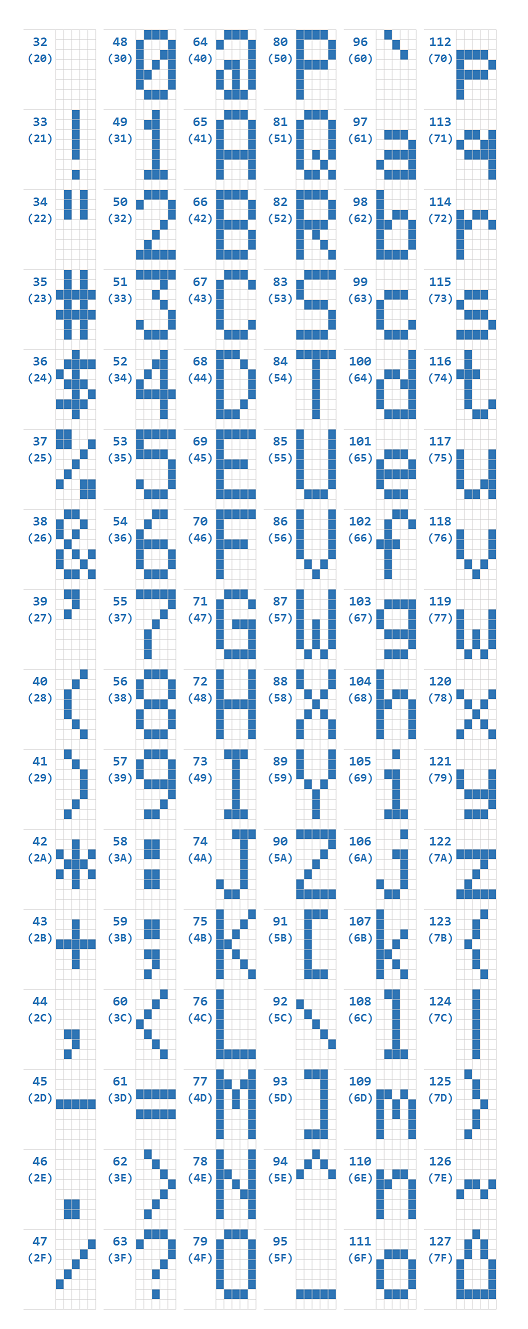
Just finished the font render part of my spreadsheet. It renders directly from the unpacked 5-byte 'input' table. Change a byte in there and you'll see the changes immediately. Mind if I show it off, guys (see below)?
Cheerful regards, Mike, K8LH
Last edited by Mike, K8LH; - 20th May 2018 at 20:03.
|
Re: Nokia lcd include , small footprint to suit pic16's
Richard... Would you be interested in seeing my driver code for font tables with 2.5 word-per-character packing instead of 3 word-per-character packing? The new '2.5' font tables use 240 words of memory (down from 288 words) and my little single file ~225 line (non-PBP) demo program now weighs in at ~406 words total memory...
Cheerful regards, Mike
Last edited by Mike, K8LH; - 24th May 2018 at 09:35.
|
Re: Nokia lcd include , small footprint to suit pic16's
yes please, I had considered doing that but could not find a method that preserved the gainRichard... Would you be interested in seeing my driver code for font tables
my attempts used half the saved space up doing the unpacking
Warning I'm not a teacher
|
Re: Nokia lcd include , small footprint to suit pic16's
First, here's how I'm packing font pattern data into 2-1/2 words within groups of 5 words;
In the first part of my WrChar() routine I calculate the table address by first subtracting the font table offset (32) from the ASCII character value (32..127). Then I multiply the resulting font table index (0..95) by 2.5 and add the integer result (0..237) to the font table base address. In my case, I'm using a fixed 0x0400 address for the font table so I don't need to perform the addition. I simply stuff the 0..237 value directly into EEADRL and the hi byte of the font table address into EEADRH.
In the other half of my WrChar() routine, if the font table index is even I print the 1st word hi & lo bytes, the 2nd word hi & lo bytes, and the 3rd word hi byte. If the font table index is odd I print the 1st word lo byte, the 2nd word hi & lo bytes, and the 3rd word hi & lo bytes. You'll notice the logic is relatively simple and unrolling the print loop to accommodate the logic doesn't seem to have incurred additional program overhead.
The new demo program (attached below) is 50 words smaller than the old (3-word-per-character) program (406 words total) so it seems I've realized the full 48 word savings from the new packed font table format.
I hope this example provides some useful ideas and I'm sorry I can't help with PBP...
Have fun... Cheerful regards, Mike
Code:/******************************************************************** * * * Project: Nokia 5110 16F1823 Demo * * Source: Nokia_5110_Packed_v2.c * * Author: Mike McLaren, K8LH * * (C)2013: Micro Application Consultants * * Date: 23-May-2018 * * * * Experimental Nokia 5110 LCD display driver demo using a 96 * * character packed 2.5-word-per-character 5x7 font table. * * * * IDE: MPLAB 8.92 (tabs = 4) * * Lang: SourceBoost BoostC v7.30, Lite/Free version * * * ********************************************************************/ #include <system.h> #pragma DATA _CONFIG1, _FOSC_INTOSC & _WDTE_OFF & _MCLRE_ON #pragma DATA _CONFIG2, _PLLEN_OFF & _LVP_OFF #pragma CLOCK_FREQ 8000000 // 8 MHz INTOSC /******************************************************************** * function prototypes * ********************************************************************/ /******************************************************************** * typedef, defines, and macros * ********************************************************************/ #define rst porta.0 // RA0 = 5110 'reset' #define dat porta.1 // RA1 = 5110 'din' #define clk porta.2 // RA2 = 5110 'clk' #define ce portc.0 // RC0 = 5110 'ce' #define dc portc.1 // RC1 = 5110 'dc' #define putlcd(x) asm movlw x \ asm call putwreg() #define putcmd(x) dc = 0; \ asm movlw x \ asm call putwreg() /******************************************************************** * variables & packed 2.5-word-per-character 5x7 font table/array * ********************************************************************/ #pragma DATA 1024, 0x0000, 0x0000, 0x0000, 0x005F, 0x0000, // 32 ' ' '!' 0x0007, 0x0007, 0x0014, 0x3F94, 0x3F94, // 34 '"' '#' 0x122A, 0x3FAA, 0x0923, 0x0988, 0x3262, // 36 '$' '%' 0x1B49, 0x2AA2, 0x2800, 0x0283, 0x0000, // 38 '&' ''' 0x001C, 0x1141, 0x0000, 0x20A2, 0x0E00, // 40 '(' ')' 0x0A08, 0x1F08, 0x0A08, 0x043E, 0x0408, // 42 '*' '+' 0x0050, 0x1800, 0x0008, 0x0408, 0x0408, // 44 ',' '-' 0x0060, 0x3000, 0x0020, 0x0808, 0x0202, // 46 '.' '/' 0x1F51, 0x24C5, 0x1F00, 0x217F, 0x2000, // 48 '0' '1' 0x2161, 0x28C9, 0x2321, 0x20C5, 0x25B1, // 50 '2' '3' 0x0C14, 0x097F, 0x0827, 0x22C5, 0x22B9, // 52 '4' '5' 0x1E4A, 0x24C9, 0x1801, 0x3889, 0x0283, // 54 '6' '7' 0x1B49, 0x24C9, 0x1B06, 0x24C9, 0x149E, // 56 '8' '9' 0x0036, 0x1B00, 0x0000, 0x2B36, 0x0000, // 58 ':' ';' 0x0414, 0x1141, 0x0014, 0x0A14, 0x0A14, // 60 '<' '=' 0x0041, 0x1114, 0x0402, 0x00D1, 0x0486, // 62 '>' '?' 0x1949, 0x3CC1, 0x1F7E, 0x0891, 0x08FE, // 64 '@' 'A' 0x3FC9, 0x24C9, 0x1B3E, 0x20C1, 0x20A2, // 66 'B' 'C' 0x3FC1, 0x20A2, 0x0E7F, 0x24C9, 0x24C1, // 68 'D' 'E' 0x3F89, 0x0489, 0x00BE, 0x20C9, 0x24FA, // 70 'F' 'G' 0x3F88, 0x0408, 0x3F80, 0x20FF, 0x2080, // 72 'H' 'I' 0x1040, 0x20BF, 0x00FF, 0x0414, 0x1141, // 74 'J' 'K' 0x3FC0, 0x2040, 0x207F, 0x010C, 0x017F, // 76 'L' 'M' 0x3F84, 0x0410, 0x3FBE, 0x20C1, 0x20BE, // 78 'N' 'O' 0x3F89, 0x0489, 0x033E, 0x20D1, 0x10DE, // 80 'P' 'Q' 0x3F89, 0x0CA9, 0x2346, 0x24C9, 0x24B1, // 82 'R' 'S' 0x0081, 0x3F81, 0x00BF, 0x2040, 0x203F, // 84 'T' 'U' 0x0FA0, 0x2020, 0x0FBF, 0x2038, 0x203F, // 86 'V' 'W' 0x3194, 0x0414, 0x3187, 0x0470, 0x0407, // 88 'X' 'Y' 0x30D1, 0x24C5, 0x2180, 0x3FC1, 0x2080, // 90 'Z' '[' 0x0104, 0x0410, 0x1000, 0x20C1, 0x3F80, // 92 '\' ']' 0x0202, 0x0082, 0x0240, 0x2040, 0x2040, // 94 '^' '_' 0x0001, 0x0104, 0x0020, 0x2A54, 0x2A78, // 96 '`' 'a' 0x3FC8, 0x2244, 0x1C38, 0x2244, 0x2220, // 98 'b' 'c' 0x1C44, 0x2248, 0x3FB8, 0x2A54, 0x2A18, // 100 'd' 'e' 0x047E, 0x0481, 0x010C, 0x2952, 0x293E, // 102 'f' 'g' 0x3F88, 0x0204, 0x3C00, 0x227D, 0x2000, // 104 'h' 'i' 0x1040, 0x223D, 0x007F, 0x0828, 0x2200, // 106 'j' 'k' 0x0041, 0x3FC0, 0x007C, 0x0218, 0x0278, // 108 'l' 'm' 0x3E08, 0x0204, 0x3C38, 0x2244, 0x2238, // 110 'n' 'o' 0x3E14, 0x0A14, 0x0408, 0x0A14, 0x0C7C, // 112 'p' 'q' 0x3E08, 0x0204, 0x0448, 0x2A54, 0x2A20, // 114 'r' 's' 0x023F, 0x2240, 0x103C, 0x2040, 0x107C, // 116 't' 'u' 0x0E20, 0x2020, 0x0E3C, 0x2030, 0x203C, // 118 'v' 'w' 0x2228, 0x0828, 0x220C, 0x2850, 0x283C, // 120 'x' 'y' 0x2264, 0x2A4C, 0x2200, 0x0436, 0x2080, // 122 'z' '{' 0x0000, 0x3F80, 0x0000, 0x20B6, 0x0400, // 124 '|' '}' 0x0808, 0x0410, 0x0478, 0x2341, 0x2378 // 126 '~' '' /******************************************************************** * * ********************************************************************/ void putwreg() // send byte, msb first (15 words) { char work; // asm movwf _work // char n = 0; ce = 0; // spi enable on do // send 8 bits { clk = 0; dat = 0; // " if(work.7) dat = 1; // " clk = 1; work <<= 1; // " n++; // " } while(n.3 == 0); // " ce = 1; // spi enable off } // /******************************************************************** * * ********************************************************************/ void RdFlash() // bank 3 (inserted by compiler) { asm bcf _eecon1,CFGS // not 'config' memory |03 asm bsf _eecon1,EEPGD // select 'program' memory |03 asm bsf _eecon1,RD // initiate read operation |03 asm nop // required nop |03 asm nop // " |03 asm incf _eeadrl,F // bump EEADR |03 asm rlf _eedatl,W // move b7 into Carry |03 asm rlf _eedath,W // wreg = the 7 bit hi byte |03 asm bcf _eedatl,7 // eedatl = the 7 bit lo byte |03 } // /******************************************************************** * * ********************************************************************/ void WrChar(char ascii) // for packed 2.5 word 5x7 font { dc = 1; // set lcd 'data' mode asm movlw -32 // ascii 32..127 minus offset |00 asm addwf _ascii,F // font array index, 0..95 |00 asm lsrf _ascii,W // int(ascii *= 2.5) -> 0..237 |00 asm addwf _ascii,W // " |00 asm addwf _ascii,W // " |00 // asm movlb 3 // bank 3 (inserted by compiler) |03 asm movwf _eeadrl // flash address lo, 0..237 |03 asm movlw 1024/256 // table address hi |03 asm movwf _eeadrh // flash address hi |03 /* * * Extract five bytes of pattern data from three memory words. * * Odd characters use word 0 lo, 1 hi + lo, and 2 hi + lo while * * even characters use word 0 hi + lo, 1 hi + lo, and 2 hi. A * * sixth blank (zero) byte is sent for inter-character spacing. * * */ asm call RdFlash() // read 1st word |03 // asm movlb 0 // bank 0 (inserted by compiler) |00 asm btfss _ascii,0 // odd char? yes, skip, else |00 asm call putwreg() // send hi byte (even character) |00 // asm movlb 3 // bank 3 |03 asm movf _eedatl,W // |03 asm call putwreg() // send lo byte |00 asm call RdFlash() // read 2nd word |03 asm call putwreg() // send hi byte |00 // asm movlb 3 // bank 3 |03 asm movf _eedatl,W // |03 asm call putwreg() // send lo byte |00 asm call RdFlash() // read 3rd word |03 asm call putwreg() // send hi byte |00 // asm movlb 3 // bank 3 |03 asm movf _eedatl,W // |03 // asm movlb 0 // bank 0 |00 asm btfsc _ascii,0 // even char? yes, skip, else |00 asm call putwreg() // send lo byte (odd characters) |00 asm movlw 0 // |00 asm call putwreg() // send blank 6th column |00 } // /******************************************************************** * * ********************************************************************/ void WrChar(rom char *data) // overload function for strings { char ndx = 0; // while(data[ndx++]) // while not end-of-string WrChar(wreg); // } // /******************************************************************** * main setup * ********************************************************************/ void main() { ansela = 0; // adc off for digital I/O anselc = 0; // " trisa = 0; // porta all outputs except RA3/MCLR trisc = 0; // portc all outputs ce = 1; // 5110 'ce' off rst = 1; // 5110 'rst' off osccon = 0b01110000; // set INTOSC to 8 MHz /* * * initialize Nokia 5110 LCD display * * */ delay_ms(30); // rst = 0; rst = 1; // 5110 'reset' pulse putcmd(0x20+0x01); // function set: extended instructions putcmd(0x80+0x30); // set Vop (contrast), 0..127 putcmd(0x04+0x02); // set temperature coefficient, 0..3 putcmd(0x10+0x03); // Set bias system, 0..7 putcmd(0x20+0x00); // function set: standard instructions putcmd(0x08+0x04); // display control: normal mode /* * * test the LCD and the print string overload function. * * */ putcmd(0x80+0x20); // set DDRAM X address, 0..83 putcmd(0x40+0x02); // set DDRAM Y address, 0..5 WrChar('H'); // write ascii character WrChar("ello"); // write ascii string /******************************************************************** * main loop * ********************************************************************/ while(1) // { // } // } //
Last edited by Mike, K8LH; - 25th May 2018 at 02:26.
|
Re: Nokia lcd include , small footprint to suit pic16's
thanks mike , the concept works nicely
xc8 version (393)+240 words , uses mssp1
Code:#include "mcc_generated_files/mcc.h" #include "FONT.c" void putwreg(char work); void putcmd(char x); void WrChar(char ascii); void WrStr(char *); void main(void) { // initialize the device SYSTEM_Initialize(); /* * * initialize Nokia 5110 LCD display * * */ __delay_ms(30); // LCD_RST_SetLow(); // 5110 'reset' pulse __delay_ms(1); LCD_RST_SetHigh(); // 5110 'reset' pulse __delay_ms(1); putcmd(0x20 + 0x01); // function set: extended instructions putcmd(0xc8); // set Vop (contrast), 0..127 putcmd(0x04 + 0x02); // set temperature coefficient, 0..3 putcmd(0x10 + 0x03); // Set bias system, 0..7 putcmd(0x20 + 0x00); // function set: standard instructions putcmd(0x08 + 0x04); // display control: normal mode putcmd(0x80 + 0x20); // set DDRAM X address, 0..83 putcmd(0x40 + 0x02); // set DDRAM Y address, 0..5 WrChar('R'); // write ascii character WrStr("eady"); while (1) { } } /** End of File */ void putwreg(char work) // send byte, msb first (15 words) { LCD_CE_LAT = 0; // spi enable on SPI1_Exchange8bit(work); while (!PIR1bits.SSP1IF); LCD_CE_LAT = 1; // spi enable off } // void WrChar(char ascii) // for packed 2.5 word 5x7 font { unsigned int dat, inx = 0x1f00; char i = 5; // char fd[6],i=5,*pt; //pt=fd; inx += ((ascii - 32)*5) >> 1; dat = FLASH_ReadWord(inx++); if (!(ascii & 1))putwreg(dat >> 7); // *pt++=dat>>7; putwreg(dat & 0x7f); //*pt++ =(char)dat&0x7f; dat = FLASH_ReadWord(inx++); putwreg(dat >> 7); putwreg(dat & 0x7f); //*pt++=dat>>7; //*pt++=(char)dat&0x7f; dat = FLASH_ReadWord(inx); //*pt++=dat>>7; putwreg(dat >> 7); if (ascii & 1) putwreg(dat & 0x7f); //*pt++=(char)dat&0x7f; //pt=fd; // while(i--){ // putwreg(*pt++); // } putwreg(0); } void putcmd(char x) { LCD_DC_SetLow(); putwreg(x); LCD_DC_SetHigh(); } void WrStr(char *buff) { { // while (*buff) // while not end-of-string WrChar(*buff++); // } }
font
Code:#include <xc.h> #asm PSECT strings,class=CODE,abs,delta=2 ORG 0x1f00 DW 0x0000, 0x0000, 0x0000, 0x005F, 0x0000 // 32 ' ' '!' DW 0x0007, 0x0007, 0x0014, 0x3F94, 0x3F94 // 34 '"' '#' DW 0x122A, 0x3FAA, 0x0923, 0x0988, 0x3262 // 36 '$' '%' DW 0x1B49, 0x2AA2, 0x2800, 0x0283, 0x0000 // 38 '&' ''' DW 0x001C, 0x1141, 0x0000, 0x20A2, 0x0E00 // 40 '(' ')' DW 0x0A08, 0x1F08, 0x0A08, 0x043E, 0x0408 // 42 '*' '+' DW 0x0050, 0x1800, 0x0008, 0x0408, 0x0408 // 44 ',' '-' DW 0x0060, 0x3000, 0x0020, 0x0808, 0x0202 // 46 '.' '/' DW 0x1F51, 0x24C5, 0x1F00, 0x217F, 0x2000 // 48 '0' '1' DW 0x2161, 0x28C9, 0x2321, 0x20C5, 0x25B1 // 50 '2' '3' DW 0x0C14, 0x097F, 0x0827, 0x22C5, 0x22B9 // 52 '4' '5' DW 0x1E4A, 0x24C9, 0x1801, 0x3889, 0x0283 // 54 '6' '7' DW 0x1B49, 0x24C9, 0x1B06, 0x24C9, 0x149E // 56 '8' '9' DW 0x0036, 0x1B00, 0x0000, 0x2B36, 0x0000 // 58 ':' ';' DW 0x0414, 0x1141, 0x0014, 0x0A14, 0x0A14 // 60 '<' '=' DW 0x0041, 0x1114, 0x0402, 0x00D1, 0x0486 // 62 '>' '?' DW 0x1949, 0x3CC1, 0x1F7E, 0x0891, 0x08FE // 64 '@' 'A' DW 0x3FC9, 0x24C9, 0x1B3E, 0x20C1, 0x20A2 // 66 'B' 'C' DW 0x3FC1, 0x20A2, 0x0E7F, 0x24C9, 0x24C1 // 68 'D' 'E' DW 0x3F89, 0x0489, 0x00BE, 0x20C9, 0x24FA // 70 'F' 'G' DW 0x3F88, 0x0408, 0x3F80, 0x20FF, 0x2080 // 72 'H' 'I' DW 0x1040, 0x20BF, 0x00FF, 0x0414, 0x1141 // 74 'J' 'K' DW 0x3FC0, 0x2040, 0x207F, 0x010C, 0x017F // 76 'L' 'M' DW 0x3F84, 0x0410, 0x3FBE, 0x20C1, 0x20BE // 78 'N' 'O' DW 0x3F89, 0x0489, 0x033E, 0x20D1, 0x10DE // 80 'P' 'Q' DW 0x3F89, 0x0CA9, 0x2346, 0x24C9, 0x24B1 // 82 'R' 'S' DW 0x0081, 0x3F81, 0x00BF, 0x2040, 0x203F // 84 'T' 'U' DW 0x0FA0, 0x2020, 0x0FBF, 0x2038, 0x203F // 86 'V' 'W' DW 0x3194, 0x0414, 0x3187, 0x0470, 0x0407 // 88 'X' 'Y' DW 0x30D1, 0x24C5, 0x2180, 0x3FC1, 0x2080 // 90 'Z' '[' DW 0x0104, 0x0410, 0x1000, 0x20C1, 0x3F80 // 92 '\' ']' DW 0x0202, 0x0082, 0x0240, 0x2040, 0x2040 // 94 '^' '_' DW 0x0001, 0x0104, 0x0020, 0x2A54, 0x2A78 // 96 '`' 'a' DW 0x3FC8, 0x2244, 0x1C38, 0x2244, 0x2220 // 98 'b' 'c' DW 0x1C44, 0x2248, 0x3FB8, 0x2A54, 0x2A18 // 100 'd' 'e' DW 0x047E, 0x0481, 0x010C, 0x2952, 0x293E // 102 'f' 'g' DW 0x3F88, 0x0204, 0x3C00, 0x227D, 0x2000 // 104 'h' 'i' DW 0x1040, 0x223D, 0x007F, 0x0828, 0x2200 // 106 'j' 'k' DW 0x0041, 0x3FC0, 0x007C, 0x0218, 0x0278 // 108 'l' 'm' DW 0x3E08, 0x0204, 0x3C38, 0x2244, 0x2238 // 110 'n' 'o' DW 0x3E14, 0x0A14, 0x0408, 0x0A14, 0x0C7C // 112 'p' 'q' DW 0x3E08, 0x0204, 0x0448, 0x2A54, 0x2A20 // 114 'r' 's' DW 0x023F, 0x2240, 0x103C, 0x2040, 0x107C // 116 't' 'u' DW 0x0E20, 0x2020, 0x0E3C, 0x2030, 0x203C // 118 'v' 'w' DW 0x2228, 0x0828, 0x220C, 0x2850, 0x283C // 120 'x' 'y' DW 0x2264, 0x2A4C, 0x2200, 0x0436, 0x2080 // 122 'z' '{' DW 0x0000, 0x3F80, 0x0000, 0x20B6, 0x0400 // 124 '|' '}' DW 0x0808, 0x0410, 0x0478, 0x2341, 0x2378 // 126 '~' '' #endasm
Last edited by richard; - 25th May 2018 at 10:42.
Warning I'm not a teacher
|
Re: Nokia lcd include , small footprint to suit pic16's
Nice to see an XC8 example excerpt...
May I ask where I can find information for placing DW data in XC8 at an absolute address, please? I haven't found it so far, nor can I get your example working in a 16F1823 XC8 project...
I'm also struggling with MCC (Microsoft Code Configurator)...
|
Re: Nokia lcd include , small footprint to suit pic16's
all my knowledge came from google" xc8 psect" , i have not found a good reference yetMay I ask where I can find information for placing DW data in XC8 at an absolute address
the xc8 use rguide/manual is severely lacking in that respect
key elements
PSECT strings,class=CODE,abs,delta=2
ORG 0x1f00
my example uses an asm segment in a c include file, it may be better to place the data in an asm file and include that instead
because i have terrible trouble getting "labels" to work properly my way. [ still learning]
mcc is a splendid thing once you get the hang of it, for the chips it supports.
once i have created the standalone project i use mcc to set the osc and create the main.c and mcc files
then you can add the pins/hw modules
|
Re: Nokia lcd include , small footprint to suit pic16's
a saner way is, and let the linker locate the font for you
font .c file
in main.cCode:#include <xc.h> #asm psect FONT_table,class=CODE,local,delta=2 GLOBAL _FNT _FNT DW 0x0000, 0x0000, 0x0000, 0x005F, 0x0000 // 32 ' ' '!' DW 0x0007, 0x0007, 0x0014, 0x3F94, 0x3F94 // 34 '"' '#' DW 0x122A, 0x3FAA, 0x0923, 0x0988, 0x3262 // 36 '$' '%' DW 0x1B49, 0x2AA2, 0x2800, 0x0283, 0x0000 // 38 '&' ''' ................
extern const char FNT;
int addr=&FNT;
in wrChar()
unsigned int dat, inx = addr;
char i = 5;
Warning I'm not a teacher
|
Re: Nokia lcd include , small footprint to suit pic16's
Hi Richard,
Well done to you and Mike for continuing the thread, even though what you are documenting is so far above my head I'm dizzy...
If I can jump in here I'd like to bring your attention to an undocumented feature of your Inc file I've just discovered when converting my previous code to run it. For various reasons, but mainly leading zero suppression, I insert a space but with your Inc file I get error messages e.g.
resulting inCode:looper: LCDCLR bigtxt = 1 ; double size chrs LCDSTR 0,0,"Noki+12" LCDSTR 0,2,"345678@" bigtxt = 0 ; normal size chrs ' LCDSTR 52,3,"Demo" LCDSTR 0,4,"With@MSSP xfer" ' LCDSTR 0,5,"Dble Size Chrs" LCDSTR 0,5," " ; this doesn't compile - causes errors and warnings wherever used. ' LCDSTR 0,5,32 ; same result as above (worth a try). PAUSE 1000 GOTO looper
[ASM ERROR] NOKIA_DEMO PPS.ASM (1701) : Illegal character (0)
[ASM WARNING] NOKIA_DEMO PPS.ASM (1701) : Found label after column 1. (LCDSTR?CCC)
When you have the time may I ask for this to be corrected?
Kind regards,
Bill
|
Re: Nokia lcd include , small footprint to suit pic16's
its a pbp problemLCDSTR 0,5," "
" " is not a String pbp interprets a single chr as a byte , regardless of the quotes . and its not possible to fix it
you can simply use
LCDC " "
or
LCDC 0,5," "
to print a single character
have a look at this
http://support.melabs.com/forum/picb...strtok-usercmd
it has a rightjustify user command in it,
eg to display a 3 digit field
Code:arraywrite buff,[dec h,0] RJUSTBUFF buff,3 LCDSTR 36,0,BUFF
Last edited by richard; - 26th May 2018 at 07:10.
Warning I'm not a teacher
|
Re: Nokia lcd include , small footprint to suit pic16's
Ah... Thank you for the PSECT search term. Got it. I also discovered that I could use a label in the font table and access that address in my code... Very exciting stuff (grin)...
I still need to double-check and simulate my XC8 version but so far it uses 381 words (141 code + 240 font). I didn't use MCC (Microchip Code Configurator) so it's a single file, about 235 lines, including the font table (see below).
MCC doesn't seem to support the MSSP module on my 16F1823 so I still need to consult the datasheet before I can implement the SPI driver.
Cheerful regards, Mike, K8LH
Code:/************************************************************************ * * * Project: Nokia_Fonts * * Source: Nokia_Main.c * * Author: Mike McLaren, K8LH * * (C)2013: Micro Application Consultants * * Date: 25-May-2018 * * * * Experimental Nokia 5110 LCD display driver demo using a 96 * * character packed 2.5-word-per-character 5x7 font table on a * * PIC16F1823. * * * * IDE: MPLABX v4.05 * * Lang: XC8 v1.45, Lite/Free version * * * ************************************************************************/ /* CONFIG1 */ #pragma config FOSC = INTOSC // INTOSC oscillator: I/O on CLKIN pin #pragma config WDTE = OFF // Watchdog Timer Enable (WDT disabled) #pragma config PWRTE = OFF // Power-up Timer Enable (PWRT disabled) #pragma config MCLRE = ON // MCLR/VPP pin function is MCLR #pragma config CP = OFF // Code protection is disabled #pragma config CPD = OFF // Data memory code protection disabled #pragma config BOREN = ON // Brown-out Reset Enable #pragma config CLKOUTEN = OFF // Clock Out Enable (off) #pragma config IESO = OFF // Internal/External Switchover (off) #pragma config FCMEN = OFF // Fail-Safe Clock Monitor Enable (off) /* CONFIG2 */ #pragma config WRT = OFF // Write protection off #pragma config PLLEN = OFF // PLL Enable (4x PLL disabled) #pragma config STVREN = ON // Stack Overflow/Underflow Reset Enable #pragma config BORV = LO // Brown-out Reset Low Trip Point #pragma config LVP = ON // Low-Voltage Programming Enable #include <xc.h> #define _XTAL_FREQ 8000000 /************************************************************************ * * ************************************************************************/ #define rst RA0 // 5110 'reset' #define dat RA1 // 5110 'din' #define clk RA2 // 5110 'clk' #define ce RC0 // 5110 'ce' #define dc RC1 // 5110 'dc' /************************************************************************ * * ************************************************************************/ void putwreg() // send byte, msb first { char work; // asm("movwf putwreg@work "); // ce = 0; // spi enable on for(char n=0; n<8; n++) // { clk = 0; dat = 0; // " if(work & 128) dat = 1; // " clk = 1; work <<= 1; // " } // ce = 1; // spi enable off } // /************************************************************************ * * ************************************************************************/ void putcmd(char cmd) // bank 0 (inserted by compiler) |00 { dc = 0; // command mode |00 asm("call _putwreg "); // |00 } /************************************************************************ * * ************************************************************************/ void rdflash() // { asm("banksel EECON1 "); // bank 3 |03 asm("bcf EECON1,6 "); // CFGS = 0 (not config) |03 asm("bsf EECON1,7 "); // EEPGD = 1 (program memory) |03 asm("bsf EECON1,0 "); // RD = 1 (initiate read) |03 asm("nop "); // required nop |03 asm("nop "); // " |03 asm("incf EEADRL,F "); // bump EEADR |03 asm("rlf EEDATL,W "); // move b7 into Carry |03 asm("rlf EEDATH,W "); // wreg = the 7 bit hi byte |03 asm("bcf EEDATL,7 "); // eedatl = the 7 bit lo byte |03 } // /************************************************************************ * * ************************************************************************/ void wrchar(char ascii) // { dc = 1; // set lcd 'data' mode |00 asm("movlw -32 "); // ascii 32..127 minus offset |00 asm("addwf wrchar@ascii,F "); // font array index, 0..95 |00 asm("lsrf wrchar@ascii,W "); // int(ascii *= 2.5) -> 0..237 |00 asm("addwf wrchar@ascii,W "); // " |00 asm("addwf wrchar@ascii,W "); // " |00 asm("movlb 3 "); // bank 3 |00 asm("movwf EEADRL "); // flash address lo |00 asm("movlw Font5x7/256 "); // |00 asm("movwf EEADRH "); // flash address hi |00 /* * * Extract five bytes of pattern data from three memory words. An * * even character uses word 0 hi + lo, 1 hi + lo, and 2 hi while * * odd characters use word 0 lo, 1 hi + lo, and 2 hi + lo. A 6th * * blank (zero) byte is sent for inter-character spacing. * * */ asm("call _rdflash "); // read 1st word (2 bytes) |03 asm("banksel wrchar@ascii "); // bank 0 |00 asm("btfss wrchar@ascii,0 "); // odd char? yes, skip, else |00 asm("call _putwreg "); // send hi byte (even character) |00 asm("banksel EEDATL "); // bank 3 |03 asm("movf EEDATL,W "); // |03 asm("call _putwreg "); // send lo byte |00 asm("call _rdflash "); // read 2nd word (2 bytes) |03 asm("call _putwreg "); // send hi byte |00 asm("banksel EEDATL "); // bank 3 |03 asm("movf EEDATL,W "); // |03 asm("call _putwreg "); // send lo byte |00 asm("call _rdflash "); // read 3rd word (2 bytes) |03 asm("call _putwreg "); // send hi byte |00 asm("banksel EEDATL "); // bank 3 |03 asm("movf EEDATL,W "); // |03 asm("banksel wrchar@ascii "); // bank 0 |00 asm("btfsc wrchar@ascii,0 "); // even char? yes, skip, else |00 asm("call _putwreg "); // send lo byte (odd characters) |00 asm("movlw 0 "); // |00 asm("call _putwreg "); // send blank 6th column |00 } /************************************************************************ * * ************************************************************************/ void putstr(const char *str) // put 'ROM' strings { char n = 0; // while(str[n++]) // { asm("call _putwreg "); // } } /************************************************************************ * main setup * ************************************************************************/ void main(void) { ANSELA = 0; // Analog off (digital I/O) ANSELC = 0; // " TRISA = 0; // TRISC = 0; // OSCCON = 0b01110000; // set INTOSC to 8-MHz /* * * initialize Nokia 5110 LCD display * * */ __delay_ms(30); // rst = 0; rst = 1; // 5110 'reset' pulse putcmd(0x20+0x01); // function set: ext instructions putcmd(0x80+0x30); // set Vop (contrast), 0..127 putcmd(0x04+0x02); // set temperature coefficient, 0..3 putcmd(0x10+0x03); // Set bias system, 0..7 putcmd(0x20+0x00); // function set: std instructions putcmd(0x08+0x04); // display control: normal mode /* * * test the lcd print functions * * */ putcmd(0x80+0x20); // set DDRAM X address, 0..83 putcmd(0x40+0x02); // set DDRAM Y address, 0..5 wrchar('R'); // putstr("eady"); // /************************************************************************ * main loop * ************************************************************************/ while(1) { // } // } // /************************************************************************ * Packed 96 character 5x7 Font, 2.5-words-per-character, 240 words * ************************************************************************/ #asm PSECT myFonts, class=CODE, abs, space=0, delta=2 ORG 700h Font5x7: dw 0x0000, 0x0000, 0x0000, 0x005F, 0x0000 ; 32 ' ' '!' dw 0x0007, 0x0007, 0x0014, 0x3F94, 0x3F94 ; 34 '"' '#' dw 0x122A, 0x3FAA, 0x0923, 0x0988, 0x3262 ; 36 '$' '%' dw 0x1B49, 0x2AA2, 0x2800, 0x0283, 0x0000 ; 38 '&' ''' dw 0x001C, 0x1141, 0x0000, 0x20A2, 0x0E00 ; 40 '(' ')' dw 0x0A08, 0x1F08, 0x0A08, 0x043E, 0x0408 ; 42 '*' '+' dw 0x0050, 0x1800, 0x0008, 0x0408, 0x0408 ; 44 ',' '-' dw 0x0060, 0x3000, 0x0020, 0x0808, 0x0202 ; 46 '.' '/' dw 0x1F51, 0x24C5, 0x1F00, 0x217F, 0x2000 ; 48 '0' '1' dw 0x2161, 0x28C9, 0x2321, 0x20C5, 0x25B1 ; 50 '2' '3' dw 0x0C14, 0x097F, 0x0827, 0x22C5, 0x22B9 ; 52 '4' '5' dw 0x1E4A, 0x24C9, 0x1801, 0x3889, 0x0283 ; 54 '6' '7' dw 0x1B49, 0x24C9, 0x1B06, 0x24C9, 0x149E ; 56 '8' '9' dw 0x0036, 0x1B00, 0x0000, 0x2B36, 0x0000 ; 58 ':' ';' dw 0x0414, 0x1141, 0x0014, 0x0A14, 0x0A14 ; 60 '<' '=' dw 0x0041, 0x1114, 0x0402, 0x00D1, 0x0486 ; 62 '>' '?' dw 0x1949, 0x3CC1, 0x1F7E, 0x0891, 0x08FE ; 64 '@' 'A' dw 0x3FC9, 0x24C9, 0x1B3E, 0x20C1, 0x20A2 ; 66 'B' 'C' dw 0x3FC1, 0x20A2, 0x0E7F, 0x24C9, 0x24C1 ; 68 'D' 'E' dw 0x3F89, 0x0489, 0x00BE, 0x20C9, 0x24FA ; 70 'F' 'G' dw 0x3F88, 0x0408, 0x3F80, 0x20FF, 0x2080 ; 72 'H' 'I' dw 0x1040, 0x20BF, 0x00FF, 0x0414, 0x1141 ; 74 'J' 'K' dw 0x3FC0, 0x2040, 0x207F, 0x010C, 0x017F ; 76 'L' 'M' dw 0x3F84, 0x0410, 0x3FBE, 0x20C1, 0x20BE ; 78 'N' 'O' dw 0x3F89, 0x0489, 0x033E, 0x20D1, 0x10DE ; 80 'P' 'Q' dw 0x3F89, 0x0CA9, 0x2346, 0x24C9, 0x24B1 ; 82 'R' 'S' dw 0x0081, 0x3F81, 0x00BF, 0x2040, 0x203F ; 84 'T' 'U' dw 0x0FA0, 0x2020, 0x0FBF, 0x2038, 0x203F ; 86 'V' 'W' dw 0x3194, 0x0414, 0x3187, 0x0470, 0x0407 ; 88 'X' 'Y' dw 0x30D1, 0x24C5, 0x2180, 0x3FC1, 0x2080 ; 90 'Z' '[' dw 0x0104, 0x0410, 0x1000, 0x20C1, 0x3F80 ; 92 '\' ']' dw 0x0202, 0x0082, 0x0240, 0x2040, 0x2040 ; 94 '^' '_' dw 0x0001, 0x0104, 0x0020, 0x2A54, 0x2A78 ; 96 '`' 'a' dw 0x3FC8, 0x2244, 0x1C38, 0x2244, 0x2220 ; 98 'b' 'c' dw 0x1C44, 0x2248, 0x3FB8, 0x2A54, 0x2A18 ; 100 'd' 'e' dw 0x047E, 0x0481, 0x010C, 0x2952, 0x293E ; 102 'f' 'g' dw 0x3F88, 0x0204, 0x3C00, 0x227D, 0x2000 ; 104 'h' 'i' dw 0x1040, 0x223D, 0x007F, 0x0828, 0x2200 ; 106 'j' 'k' dw 0x0041, 0x3FC0, 0x007C, 0x0218, 0x0278 ; 108 'l' 'm' dw 0x3E08, 0x0204, 0x3C38, 0x2244, 0x2238 ; 110 'n' 'o' dw 0x3E14, 0x0A14, 0x0408, 0x0A14, 0x0C7C ; 112 'p' 'q' dw 0x3E08, 0x0204, 0x0448, 0x2A54, 0x2A20 ; 114 'r' 's' dw 0x023F, 0x2240, 0x103C, 0x2040, 0x107C ; 116 't' 'u' dw 0x0E20, 0x2020, 0x0E3C, 0x2030, 0x203C ; 118 'v' 'w' dw 0x2228, 0x0828, 0x220C, 0x2850, 0x283C ; 120 'x' 'y' dw 0x2264, 0x2A4C, 0x2200, 0x0436, 0x2080 ; 122 'z' '{' dw 0x0000, 0x3F80, 0x0000, 0x20B6, 0x0400 ; 124 '|' '}' dw 0x0808, 0x0410, 0x0478, 0x2341, 0x2378 ; 126 '~' '' #endasm /************************************************************************/
Last edited by Mike, K8LH; - 26th May 2018 at 07:42.
|
Re: Nokia lcd include , small footprint to suit pic16's
mike
mssp is pretty easy
SSP1CON1=0x21 ;$22,21,20 all work @32mhz 20 is fastest
SSP1STAT=0x40
sdo and sck pins set to dig o/p
to transfer data
PIR1.3=0
SSP1BUF = data
WHILE (!PIR1.3) ;
tried your code on 16f1847 ,its not working
Warning I'm not a teacher
|
Re: Nokia lcd include , small footprint to suit pic16's
It seems XC8 is placing my program code on top of my font table in the 0700h area of memory. More detective work (sigh)...
Thanks for the MSSP/SPI info, Richard. I will get to that after tracking down the current problem...
Mike
<added>
If you get a chance, add the "ovrld" param' to the following line and tell me if that fixes the problem, please?
Code:PSECT myFonts, class=CODE, abs, ovrld, space=0, delta=2 ^^^^^
Last edited by Mike, K8LH; - 26th May 2018 at 14:55.
|
Re: Nokia lcd include , small footprint to suit pic16's
ovrld,
does not fix it
even local too
there is more wrong than just that , the putwreg function is getting called six times for the wrchar
and only 5 times for the entire putstr call
its a total bitch to debug with all that inline asm , the debugger just
goes stupid
putcmd looks fine on the logic analyser , it all goes pear shaped from then on
Warning I'm not a teacher
|
Re: Nokia lcd include , small footprint to suit pic16's
Sorry, Richard (and gang). A bug at the very top of the putchar() routine was messing up the font table address. And yes, I know assembler is a PITA... I wish I could get a gratis copy of PBP...
Corrected version attached (375 words total). I still need to dig out my old Nokia 5110 display and test this on real hardware. I also have a tiny 128x32 I2C OLED display and a tiny 128x64 SPI OLED display to play with sometime soon.
Cheerful regards, Mike
Nokia_Main.c.txt
|
Re: Nokia lcd include , small footprint to suit pic16's
putstr still not working
I think it should look like this, but it only works for the first call
so I get "Re and then garbage
Code:void putstr(const char *str) // put 'ROM' strings { // while(*str) wrchar(*str++); } //
Warning I'm not a teacher
|
Re: Nokia lcd include , small footprint to suit pic16's
more oddly
strcpy(buff,"eady");
putstr(buff);
works with my modified routine
putstr("eady");
crashes the show
Warning I'm not a teacher
|
Re: Nokia lcd include , small footprint to suit pic16's
fixed it, compiler optimised ascii var outCode:void wrchar(char d) // { volatile char ascii=d;
Warning I'm not a teacher
|
Re: Nokia lcd include , small footprint to suit pic16's
Yes, your putstr() routine is better...
While debugging I've found XC8 is using the same memory location for local variables in both the wrchar() and putstr() functions. The wrchar@ascii variable is using 70h and the putstr@str pointer is using 70h and 71h. Is this a result of my heavy use of assembly code? That is, XC8 doesn't realize those local variables need to be unique? How do I get XC8 to use unique memory locations for those local variables?
|
Re: Nokia lcd include , small footprint to suit pic16's
make them static
Warning I'm not a teacher
|
Re: Nokia lcd include , small footprint to suit pic16's
I think I prefer my take on this
since:-
the font is automatically located
the pin/hw defines are in mcc ,therefore its simple to port to any chip that can read its own flash
its easy to debug
bigtext and inverted text are easily implemented
its only 100 or so words bigger
font.cCode:/** Product Revision : PIC10 / PIC12 / PIC16 / PIC18 MCUs - 1.65.2 Device : PIC16F1847 Driver Version : 2.00 * font.c included via ide source files */ #include "mcc_generated_files/mcc.h" void putwreg(char work); void putcmd(char x); void WrChar(char ); void WrStr(const char *); extern const char FNT; void main(void) { // initialize the device SYSTEM_Initialize(); /* * * initialize Nokia 5110 LCD display * * */ __delay_ms(30); // LCD_RST_SetLow(); // 5110 'reset' pulse __delay_ms(1); LCD_RST_SetHigh(); // 5110 'reset' pulse __delay_ms(1); putcmd(0x20 + 0x01); // function set: extended instructions putcmd(0xc8); // set Vop (contrast), 0..127 putcmd(0x04 + 0x02); // set temperature coefficient, 0..3 putcmd(0x10 + 0x03); // Set bias system, 0..7 putcmd(0x20 + 0x00); // function set: standard instructions putcmd(0x08 + 0x04); // display control: normal mode putcmd(0x80 + 0x20); // set DDRAM X address, 0..83 putcmd(0x40 + 0x02); // set DDRAM Y address, 0..5 WrChar('R'); // write ascii character WrStr("eady"); while (1) { } } /** End of File */ void putwreg(char work) // send byte, msb first (15 words) { LCD_CE_LAT = 0; // spi enable on SPI1_Exchange8bit(work); while (!PIR1bits.SSP1IF); LCD_CE_LAT = 1; // spi enable off } // void WrChar(char d) { // for packed 2.5 word 5x7 font uint16_t tmp, inx = (uint16_t) & FNT; char fd[6], j = 0, k = 3, *pt; inx += ((uint16_t) (d - 32)*5) >> 1; while (k--) { tmp = FLASH_ReadWord(inx++); fd[j + 1] = tmp & 0x7f; tmp <<= 1; fd[j] = tmp >> 8; j += 2; } pt = fd; if ((d & 1))pt++; k = 5; // with font now stored in bufer fd its easy to have large and/or inverted text while (k--) { putwreg(*pt++); } putwreg(0); } void putcmd(char x) { LCD_DC_SetLow(); putwreg(x); LCD_DC_SetHigh(); } void WrStr(const char *buff) { { // while (*buff) WrChar(*buff++); // } }
Code:#include <xc.h> #asm psect FONT_table,class=CODE,local,delta=2 GLOBAL _FNT _FNT DW 0x0000, 0x0000, 0x0000, 0x005F, 0x0000 // 32 ' ' '!' DW 0x0007, 0x0007, 0x0014, 0x3F94, 0x3F94 // 34 '"' '#' DW 0x122A, 0x3FAA, 0x0923, 0x0988, 0x3262 // 36 '$' '%' DW 0x1B49, 0x2AA2, 0x2800, 0x0283, 0x0000 // 38 '&' ''' DW 0x001C, 0x1141, 0x0000, 0x20A2, 0x0E00 // 40 '(' ')' DW 0x0A08, 0x1F08, 0x0A08, 0x043E, 0x0408 // 42 '*' '+' DW 0x0050, 0x1800, 0x0008, 0x0408, 0x0408 // 44 ',' '-' DW 0x0060, 0x3000, 0x0020, 0x0808, 0x0202 // 46 '.' '/' DW 0x1F51, 0x24C5, 0x1F00, 0x217F, 0x2000 // 48 '0' '1' DW 0x2161, 0x28C9, 0x2321, 0x20C5, 0x25B1 // 50 '2' '3' DW 0x0C14, 0x097F, 0x0827, 0x22C5, 0x22B9 // 52 '4' '5' DW 0x1E4A, 0x24C9, 0x1801, 0x3889, 0x0283 // 54 '6' '7' DW 0x1B49, 0x24C9, 0x1B06, 0x24C9, 0x149E // 56 '8' '9' DW 0x0036, 0x1B00, 0x0000, 0x2B36, 0x0000 // 58 ':' ';' DW 0x0414, 0x1141, 0x0014, 0x0A14, 0x0A14 // 60 '<' '=' DW 0x0041, 0x1114, 0x0402, 0x00D1, 0x0486 // 62 '>' '?' DW 0x1949, 0x3CC1, 0x1F7E, 0x0891, 0x08FE // 64 '@' 'A' DW 0x3FC9, 0x24C9, 0x1B3E, 0x20C1, 0x20A2 // 66 'B' 'C' DW 0x3FC1, 0x20A2, 0x0E7F, 0x24C9, 0x24C1 // 68 'D' 'E' DW 0x3F89, 0x0489, 0x00BE, 0x20C9, 0x24FA // 70 'F' 'G' DW 0x3F88, 0x0408, 0x3F80, 0x20FF, 0x2080 // 72 'H' 'I' DW 0x1040, 0x20BF, 0x00FF, 0x0414, 0x1141 // 74 'J' 'K' DW 0x3FC0, 0x2040, 0x207F, 0x010C, 0x017F // 76 'L' 'M' DW 0x3F84, 0x0410, 0x3FBE, 0x20C1, 0x20BE // 78 'N' 'O' DW 0x3F89, 0x0489, 0x033E, 0x20D1, 0x10DE // 80 'P' 'Q' DW 0x3F89, 0x0CA9, 0x2346, 0x24C9, 0x24B1 // 82 'R' 'S' DW 0x0081, 0x3F81, 0x00BF, 0x2040, 0x203F // 84 'T' 'U' DW 0x0FA0, 0x2020, 0x0FBF, 0x2038, 0x203F // 86 'V' 'W' DW 0x3194, 0x0414, 0x3187, 0x0470, 0x0407 // 88 'X' 'Y' DW 0x30D1, 0x24C5, 0x2180, 0x3FC1, 0x2080 // 90 'Z' '[' DW 0x0104, 0x0410, 0x1000, 0x20C1, 0x3F80 // 92 '\' ']' DW 0x0202, 0x0082, 0x0240, 0x2040, 0x2040 // 94 '^' '_' DW 0x0001, 0x0104, 0x0020, 0x2A54, 0x2A78 // 96 '`' 'a' DW 0x3FC8, 0x2244, 0x1C38, 0x2244, 0x2220 // 98 'b' 'c' DW 0x1C44, 0x2248, 0x3FB8, 0x2A54, 0x2A18 // 100 'd' 'e' DW 0x047E, 0x0481, 0x010C, 0x2952, 0x293E // 102 'f' 'g' DW 0x3F88, 0x0204, 0x3C00, 0x227D, 0x2000 // 104 'h' 'i' DW 0x1040, 0x223D, 0x007F, 0x0828, 0x2200 // 106 'j' 'k' DW 0x0041, 0x3FC0, 0x007C, 0x0218, 0x0278 // 108 'l' 'm' DW 0x3E08, 0x0204, 0x3C38, 0x2244, 0x2238 // 110 'n' 'o' DW 0x3E14, 0x0A14, 0x0408, 0x0A14, 0x0C7C // 112 'p' 'q' DW 0x3E08, 0x0204, 0x0448, 0x2A54, 0x2A20 // 114 'r' 's' DW 0x023F, 0x2240, 0x103C, 0x2040, 0x107C // 116 't' 'u' DW 0x0E20, 0x2020, 0x0E3C, 0x2030, 0x203C // 118 'v' 'w' DW 0x2228, 0x0828, 0x220C, 0x2850, 0x283C // 120 'x' 'y' DW 0x2264, 0x2A4C, 0x2200, 0x0436, 0x2080 // 122 'z' '{' DW 0x0000, 0x3F80, 0x0000, 0x20B6, 0x0400 // 124 '|' '}' DW 0x0808, 0x0410, 0x0478, 0x2341, 0x2378 // 126 '~' '' #endasm
Warning I'm not a teacher
|
Re: Nokia lcd include , small footprint to suit pic16's
tried a pbp version for the 5 byte compressed packed font, the unpacking done without asm
takes more code space than the compressing saves
inc file
Code:'**************************************************************** '* Name : NOKIA_ds5.INC * '* Author : richard * '* Notice : * '* : * '* Date : 26/05/2018 * '* Version : 1.0b mssp1 version bigtxt * '* Notes : inverse text mike 5 byte font version * '* :FOR pic 16/18 NOKIA LCD * '**************************************************************** goto overglcd ;################################################################## ; adjust these definitions to suit and place in main prg '#DEFINE PIC16 1 ;IF PIC18 NOT USED '#define use_mssp 1 ;if mssp used DON'T FORGET to set sdo and sck pins as o/p's ' lcdheight con 5 ; 6 PAGES ' lcdwidth con 84 ; 84 PIXELS WIDE ;--------------ONLY IF MSSP NOT USED--------------- ' LCD_CLK var Portb.4 ' Clock ' LCD_DIN var Portb.2 ' Data ;----------------------------------------- ' LCD_RST var PortA.4 ' LCD_DC var PortA.3 ' LCD_CE var LATA.6 ' LCD_LIGHT var PortA.0 ;################################################################## USERCOMMAND "LCDC" ;X,Y,CHR 0 < X < 84 , 0 < Y < 7 31 < CHR > 127 USERCOMMAND "LCDCLR" ;clear LCD USERCOMMAND "LCDSTR" ;STRING @ X,Y or Constant String USERCOMMAND "LCDCMD" ;cmd BYTE TO LCD USERCOMMAND "LCDDAT" ;DATA BYTE TO LCD ASM ;----[const String]--------------------------------------------------------------- LCDSTR?CCS macro Xin ,Yin,Cin IFNDEF TBLPTRL local TheString, OverStr ; define local labels so you can call macro multiple times goto OverStr ; goto over string stored in FLASH, so processor can't execute that TheString ;label to get address of your string da Cin, 0 ;add string to flash at TheString address and end string with 0 OverStr MOVE?CW TheString, _glcd_bigaddress MOVE?CB Xin , _POSX MOVE?CB Yin , _POSY L?CALL _GlcdUnpackStr ELSE local TheString, OverStr ; define local labels so you can call macro multiple times goto OverStr ; goto over string stored in FLASH, so processor can't execute that TheString ;label to get address of your string data Cin, 0 ;add string to flash at TheString address and end string with 0 OverStr movlw UPPER TheString movwf TBLPTRU movlw HIGH TheString movwf TBLPTRH movlw LOW TheString movwf TBLPTRL MOVE?CB Xin , _POSX MOVE?CB Yin , _POSY L?CALL GLCD_Cstr_out ENDIF endm ;----------------------Strings------------------------------------ LCDSTR?CBB macro Xin ,Yin ,Bin MOVE?CB Xin , _POSX MOVE?BB Yin , _POSY MOVE?CB high Bin, FSR1H ;load highbyte MOVE?CB low Bin, FSR1L ;load low byte L?CALL GLCD_str_out endm LCDSTR?CCB macro Xin ,Yin ,Bin MOVE?CB Xin , _POSX MOVE?CB Yin ,_POSY MOVE?CB high (Bin), FSR1H ;load highbyte MOVE?CB low (Bin), FSR1L ;load low byte L?CALL GLCD_str_out endm LCDSTR?BBB macro Xin ,Yin ,Bin MOVE?B Xin, _POSX MOVE?B Yin, _POSY MOVE?CB high Bin, FSR1H ;load highbyte MOVE?CB low Bin, FSR1L ;load low byte L?CALL GLCD_str_out endm LCDSTR?WBB macro Xin ,Yin ,Bin MOVE?WB Xin, _POSX MOVE?BB Yin, _POSY MOVE?CB high Bin, FSR1H ;load highbyte MOVE?CB low Bin, FSR1L ;load low byte L?CALL GLCD_str_out endm LCDSTR?WWB macro Xin ,Yin ,Bin MOVE?WB Xin, _POSX MOVE?WB Yin, _POSY MOVE?CB high Bin, FSR1H ;load highbyte MOVE?CB low Bin, FSR1L ;load low byte L?CALL GLCD_str_out endm LCDCMD?C macro Cin MOVE?CT 0,_LCD_DC MOVE?CB Cin , _lcdData L?CALL _lcd_byte endm LCDCMD?B macro Cin MOVE?CT 0,_LCD_DC MOVE?BB Cin , _lcdData L?CALL _lcd_byte endm LCDCMD?W macro Cin MOVE?CT 0,_LCD_DC MOVE?WB Cin , _lcdData L?CALL _lcd_byte endm LCDDAT?C macro Cin MOVE?CT 1,_LCD_DC MOVE?CB Cin , _lcdData L?CALL _lcd_byte endm LCDDAT?B macro Cin MOVE?CT 1,_LCD_DC MOVE?BB Cin , _lcdData L?CALL _lcd_byte endm LCDDAT?W macro Cin MOVE?CT 1,_LCD_DC MOVE?WB Cin , _lcdData L?CALL _lcd_byte endm LCDCLR? macro L?CALL _lcd_clr endm ;----------------------Character @ X,Y ------------------------------------ LCDC?BBB macro Xin ,Yin , Bin MOVE?BB Xin, _POSX MOVE?BB Yin, _POSY MOVE?BB Bin, _glcdCh L?CALL _gcga endm LCDC?WBB macro Xin ,Yin , Bin MOVE?WB Xin, _POSX MOVE?BB Yin, _POSY MOVE?BB Bin, _glcdCh L?CALL _gcga endm LCDC?WWB macro Xin ,Yin , Bin MOVE?WB Xin, _POSX MOVE?WB Yin, _POSY MOVE?BB Bin, _glcdCh L?CALL _gcga endm LCDC?BBC macro Xin ,Yin , Cin MOVE?BB Xin, _POSX MOVE?BB Yin, _POSY MOVE?CB Cin ,_glcdCh L?CALL _gcga endm LCDC?WBC macro Xin ,Yin , Cin MOVE?WB Xin, _POSX MOVE?BB Yin, _POSY MOVE?CB Cin ,_glcdCh L?CALL _gcga endm LCDC?CCC macro Xin ,Yin ,Cin MOVE?CB Xin , _POSX MOVE?CB Yin, _POSY MOVE?CB Cin, _glcdCh L?CALL _gcga endm LCDC?CCB macro Xin ,Yin ,Bin MOVE?CB Xin , _POSX MOVE?CB Yin, _POSY MOVE?BB Bin, _glcdCh L?CALL _gcga endm LCDC?B macro Bin MOVE?BB Bin, _glcdCh L?CALL _gcga endm GLetAddress macro Label, Wout CHK?RP Wout movlw low Label ; get low byte movwf Wout movlw High Label ; get high byte movwf Wout + 1 BANKSEL 0 endm IFDEF TBLPTRL GLCD_Cstr_out tblrd *+ movf TABLAT,w bz GLCD_exit_Cstr_out ; EXIT ON Null char CHK?RP _glcdCh MOVWF _glcdCh CHK?RP _glcd_bigaddress movff TBLPTRU,_glcd_bigaddress movff TBLPTRH,_glcd_bigaddress+1 movff TBLPTRL,_glcd_bigaddress+2 L?CALL _gcga CHK?RP _glcd_bigaddress movff _glcd_bigaddress ,TBLPTRU movff _glcd_bigaddress+1 ,TBLPTRH movff _glcd_bigaddress+2 ,TBLPTRL bra GLCD_Cstr_out GLCD_exit_Cstr_out BANKSEL 0 return GLCD_str_out movf POSTINC1, W ; Get a character bz GLCD_exit_strout ; EXIT ON Null char CHK?RP _glcdCh MOVWF _glcdCh BANKSEL 0 L?CALL _gcga bra GLCD_str_out GLCD_exit_strout BANKSEL 0 return ELSE GLCD_str_out IFDEF BSR MOVIW FSR1++ ; Get a character BTFSC STATUS,Z BRA GLCD_exit_strout ; EXIT ON Null char ELSE movf INDF, W ; Get a character BTFSC STATUS,Z GOTO GLCD_exit_strout ; EXIT ON Null char INCF FSR,F ENDIF CHK?RP _glcdCh MOVWF _glcdCh MOVE?BB FSR1L,_glcd_bigaddress MOVE?BB FSR1H,_glcd_bigaddress+1 BANKSEL 0 L?CALL _gcga MOVE?BB _glcd_bigaddress,FSR1L MOVE?BB _glcd_bigaddress+1,FSR1H GOTO GLCD_str_out GLCD_exit_strout BANKSEL 0 return ENDIF endasm glcd_bigaddress VAR BYTE[3] glcdCh var byte 'chr DATA lcdData VAR byte 'DATA glcdDC VAR BYTE 'gca var glcdFont var word 'font address glcdOffset VAR word 'font offset dsfbuff var byte[26] ctemp1 var word gl var byte glcdBc var byte POSY var byte 'gca pg address gy_ var byte 'gca pg address POSX var byte 'gca row address gx_ var byte 'gca row address ctemp var word glcdStrAddr var word ext bigtxt var bit inverted var bit @glcdStrAddr = _glcd_bigaddress GlcdUnpackStr: readcode glcdStrAddr,CTEMP glcd_bigaddress[2] = CTEMP&$7f ctemp=ctemp<<1 glcdCh = CTEMP.HIGHBYTE glcdStrAddr=glcdStrAddr+1 if glcdCh then gosub gcga glcdCh = glcd_bigaddress[2] else return endif if glcdCh then gosub gcga else return endif goto GlcdUnpackStr: return lcd_init: @ GLetAddress _font7x5,_glcdFont bigtxt = 0 inverted =0 #ifdef use_mssp SSP1CON1=$21 ;$22,21,20 all work @32mhz 20 is fastest SSP1STAT=$40 #endif LCD_CE=1 pause 30 Lcd_RST = 0 ' Reset LCD (HW reset) pause 1 Lcd_RST = 1 ' Release Reset ' lcd_dc=0 LCDCMD $21 ' LCD EXTENDED COMMANDS LCDCMD $c8 ' SET LCD Vop (CONTRAST) initial value $C8 = 200. LCDCMD $06 ' SET TEMP COEFFICIENT LCDCMD $13 ' LCD BIAS MODE LCDCMD $20 ' LCD STANDARD COMMANDS LCDCMD $08 ' LCD blank LCDCMD $0c ' LCD IN NORMAL MODE return lcd_clr: ' clear FOR gy_ =0 TO 5 FOR GX_=0 TO 83 LCDDAT 0 NEXT NEXT return lcd_byte: 'send command sequence "glcdData " LCD_CE=0 #ifdef use_mssp PIR1.3=0 SSP1BUF = LcdData WHILE !PIR1.3 : wend #else PAUSEUS 150 SHiftOUT LCD_DIN,LCD_CLK,1,[LcdData] #endif LCD_CE=1 return LCDxy: ;set LCD XY POSY = POSY MIN lcdheight POSX = POSX MIN lcdwidth LCDCMD POSY|$40 LCDCMD POSX|$80 return gcga: ;unpack font from flash and display it #ifdef PIC16 glcdOffset = (glcdch-32)*5/2 + glcdFont ; point to cga data #ELSE glcdOffset = (glcdch-32)*6 + glcdFont ; point to cga data #ENDIF gosub LCDxy #ifdef PIC16 ' ; COMMENT OUT THIS ASM SECTION IF CHIP HAS NO EEDAT REG ' ASM ' MOVE?CB high _dsfbuff, FSR1H ;load highbyte ' MOVE?CB low _dsfbuff, FSR1L ;load low byte ' MOVE?WW _glcdOffset,EEADRL ' MOVE?CB 3,_glcdDC 'nxtf ' BANKSEL EECON1 ' BSF EECON1, EEPGD ;Point to PROGRAM memory ' BSF EECON1, RD ;EE Read ' NOP ' NOP ' RLF EEDAT, W ' RLF EEDATH, W ' MOVE?AB _glcdBc ' BANKSEL EEDAT ' BCF EEDAT,7 ' MOVF EEDAT,W ' MOVWI FSR1++ ' MOVE?BA _glcdBc ' MOVWI FSR1++ ' BANKSEL EEADRL ' incf EEADRL,F ' btfsc STATUS,Z ' incf EEADRH,F ' BANKSEL _glcdDC ' DECFSZ _glcdDC,F ;dec count ' GOTO nxtf ' BANKSEL 0 ' ENDASM ; UNCOMMENT IF CHIP HAS NO EEDAT REG glcdBc=0 gosub getflash if !glcdch.0 then dsfbuff[glcdBc] = CTEMP.HIGHBYTE glcdBc=glcdBc+1 endif dsfbuff[glcdBc] = glcdDC glcdBc=glcdBc+1 gosub getflash dsfbuff[glcdBc] = CTEMP.HIGHBYTE glcdBc=glcdBc+1 dsfbuff[glcdBc] = glcdDC glcdBc=glcdBc+1 gosub getflash dsfbuff[glcdBc] = CTEMP.HIGHBYTE if glcdch.0 then glcdBc=glcdBc+1 dsfbuff[glcdBc] = glcdDC endif dsfbuff[5] = 0 #else for glcddc = 0 to 2 dsfbuff[glcddc*2] = CTEMP dsfbuff[glcddc*2+1] = CTEMP.HIGHBYTE glcdOffset = glcdOffset + 2 NEXT #endif if inverted then for glcddc = 5 to 0 STEP -1 dsfbuff[glcddc]=~dsfbuff[glcddc] next endif if bigtxt then ;create a big chr from a small one DSFBUFF[24] = POSX DSFBUFF[25] = POSy for glcddc = 5 to 0 STEP -1 ctemp = 0 ctemp1 = 3 gL = dsfbuff[glcddc] for glcdBc = 0 to 7 IF GL & 1 THEN ctemp = ctemp|ctemp1 ctemp1 = ctemp1<<2 GL = GL>>1 NEXT gL = glcddc*2 dsfbuff[GL] =ctemp.LOWBYTE dsfbuff[GL+1] =ctemp.LOWBYTE dsfbuff[GL+12]=ctemp.HIGHBYTE dsfbuff[GL+13]=ctemp.HIGHBYTE NEXT for glcddc = 0 to 11 LCDDAT dsfbuff[GLCDDC] NEXT POSY=POSY+1 POSX=DSFBUFF[24] gosub LCDxy for glcddc = 12 to 23 LCDDAT dsfbuff[GLCDDC] NEXT POSx = POSX + 12 IF POSX > 72 THEN POSX=0 ;wrap posy=DSFBUFF[25] else for glcddc = 0 to 5 LCDDAT dsfbuff[GLCDDC] NEXT POSx = POSX + 6 IF POSX > 78 THEN POSX=0 ;wrap endif RETURN getflash: readcode glcdOffset,CTEMP glcdDC= CTEMP&$7f ctemp = ctemp << 1 glcdOffset = glcdOffset + 1 return overglcd :
demo file
Code:'**************************************************************** '* Name : NOKIA_DEMO.PBP * '* Author : richard * '* Notice : * '* : * '* Date : 16/5/2018 * '* Version : mssp1 version with bigtxt ,inverse txt * '* Notes : used mikes compressed packed 5 byte font * '* :FOR pic 16F1847@32MHZ NOKIA * '**************************************************************** #CONFIG ; 16FF1847. __config _CONFIG1, _FOSC_INTOSC & _WDTE_ON & _PWRTE_ON & _MCLRE_ON & _CP_OFF & _BOREN_OFF __config _CONFIG2, _PLLEN_OFF & _LVP_OFF #ENDCONFIG define OSC 32 ; --- *** Oscillator *** --------------------------------------------------- OSCCON = %11110000 ;32 MHz, ANSELb = 0 ANSELA = 0 TRISA=%10010000 TRISB=%11101011 ;DEFINES FOR DISPLAY use font7x5_16.bas or font7x5_18.bas for pic18 #DEFINE PIC16 1 #define use_mssp 1 lcdheight con 5 ; 6 PAGES lcdwidth con 83 ; 84 PIXELS WIDE ' LCD_CLK var LATB.4 ' SCK1 pin needs to be set as dig o/p ' LCD_DIN var LATB.2 ' SDO1 pin needs to be set as dig o/p LCD_RST var LATA.4 LCD_DC var LATA.3 LCD_CE var LATA.6 LCD_LIGHT var LATA.0 BUFF VAR BYTE [16] char VAR BYTE Include "nokia_ds5.inc" ' bring it in include "font7x5_16_5.bas" '========================== MAIN Routine ============================== gosub lcd_init LCDCLR ARRAYWRITE BUFF,["READY",0] inverted=1 LCDSTR 5,2,BUFF PAUSE 1000 LCDCLR inverted=0 bigtxt = 1 LCDSTR 5,2,BUFF PAUSE 1000 LCDCLR bigtxt = 0 posx=0 posy=0 gosub LCDxy char=32 looper: lcdc char while posx char=char+1 if char>127 then char=32 lcdc char PAUSE 100 wend posy=posy+1 if posy>5 then posy=0 gosub LCDxy PAUSE 1000 endif GOTO LOOPER ' END
font
Code:'**************************************************************** '* Name : font7x5_16_5.BAS * '* Author : mike * '* Notice : * '* : * '* Date : * '* Version : 1.0 * '* Notes : * '* : * '**************************************************************** goto overfont font7x5: ;14BIT PACKED FORMAT [2X7BITS] CHR32-126 [SP TO ~ ] asm dw 0x0000, 0x0000, 0x0000, 0x005F, 0x0000 ; 32 ' ' '!' dw 0x0007, 0x0007, 0x0014, 0x3F94, 0x3F94 ; 34 '"' '#' dw 0x122A, 0x3FAA, 0x0923, 0x0988, 0x3262 ; 36 '$' '%' dw 0x1B49, 0x2AA2, 0x2800, 0x0283, 0x0000 ; 38 '&' ''' dw 0x001C, 0x1141, 0x0000, 0x20A2, 0x0E00 ; 40 '(' ')' dw 0x0A08, 0x1F08, 0x0A08, 0x043E, 0x0408 ; 42 '*' '+' dw 0x0050, 0x1800, 0x0008, 0x0408, 0x0408 ; 44 ',' '-' dw 0x0060, 0x3000, 0x0020, 0x0808, 0x0202 ; 46 '.' '/' dw 0x1F51, 0x24C5, 0x1F00, 0x217F, 0x2000 ; 48 '0' '1' dw 0x2161, 0x28C9, 0x2321, 0x20C5, 0x25B1 ; 50 '2' '3' dw 0x0C14, 0x097F, 0x0827, 0x22C5, 0x22B9 ; 52 '4' '5' dw 0x1E4A, 0x24C9, 0x1801, 0x3889, 0x0283 ; 54 '6' '7' dw 0x1B49, 0x24C9, 0x1B06, 0x24C9, 0x149E ; 56 '8' '9' dw 0x0036, 0x1B00, 0x0000, 0x2B36, 0x0000 ; 58 ':' ';' dw 0x0414, 0x1141, 0x0014, 0x0A14, 0x0A14 ; 60 '<' '=' dw 0x0041, 0x1114, 0x0402, 0x00D1, 0x0486 ; 62 '>' '?' dw 0x1949, 0x3CC1, 0x1F7E, 0x0891, 0x08FE ; 64 '@' 'A' dw 0x3FC9, 0x24C9, 0x1B3E, 0x20C1, 0x20A2 ; 66 'B' 'C' dw 0x3FC1, 0x20A2, 0x0E7F, 0x24C9, 0x24C1 ; 68 'D' 'E' dw 0x3F89, 0x0489, 0x00BE, 0x20C9, 0x24FA ; 70 'F' 'G' dw 0x3F88, 0x0408, 0x3F80, 0x20FF, 0x2080 ; 72 'H' 'I' dw 0x1040, 0x20BF, 0x00FF, 0x0414, 0x1141 ; 74 'J' 'K' dw 0x3FC0, 0x2040, 0x207F, 0x010C, 0x017F ; 76 'L' 'M' dw 0x3F84, 0x0410, 0x3FBE, 0x20C1, 0x20BE ; 78 'N' 'O' dw 0x3F89, 0x0489, 0x033E, 0x20D1, 0x10DE ; 80 'P' 'Q' dw 0x3F89, 0x0CA9, 0x2346, 0x24C9, 0x24B1 ; 82 'R' 'S' dw 0x0081, 0x3F81, 0x00BF, 0x2040, 0x203F ; 84 'T' 'U' dw 0x0FA0, 0x2020, 0x0FBF, 0x2038, 0x203F ; 86 'V' 'W' dw 0x3194, 0x0414, 0x3187, 0x0470, 0x0407 ; 88 'X' 'Y' dw 0x30D1, 0x24C5, 0x2180, 0x3FC1, 0x2080 ; 90 'Z' '[' dw 0x0104, 0x0410, 0x1000, 0x20C1, 0x3F80 ; 92 '\' ']' dw 0x0202, 0x0082, 0x0240, 0x2040, 0x2040 ; 94 '^' '_' dw 0x0001, 0x0104, 0x0020, 0x2A54, 0x2A78 ; 96 '`' 'a' dw 0x3FC8, 0x2244, 0x1C38, 0x2244, 0x2220 ; 98 'b' 'c' dw 0x1C44, 0x2248, 0x3FB8, 0x2A54, 0x2A18 ; 100 'd' 'e' dw 0x047E, 0x0481, 0x010C, 0x2952, 0x293E ; 102 'f' 'g' dw 0x3F88, 0x0204, 0x3C00, 0x227D, 0x2000 ; 104 'h' 'i' dw 0x1040, 0x223D, 0x007F, 0x0828, 0x2200 ; 106 'j' 'k' dw 0x0041, 0x3FC0, 0x007C, 0x0218, 0x0278 ; 108 'l' 'm' dw 0x3E08, 0x0204, 0x3C38, 0x2244, 0x2238 ; 110 'n' 'o' dw 0x3E14, 0x0A14, 0x0408, 0x0A14, 0x0C7C ; 112 'p' 'q' dw 0x3E08, 0x0204, 0x0448, 0x2A54, 0x2A20 ; 114 'r' 's' dw 0x023F, 0x2240, 0x103C, 0x2040, 0x107C ; 116 't' 'u' dw 0x0E20, 0x2020, 0x0E3C, 0x2030, 0x203C ; 118 'v' 'w' dw 0x2228, 0x0828, 0x220C, 0x2850, 0x283C ; 120 'x' 'y' dw 0x2264, 0x2A4C, 0x2200, 0x0436, 0x2080 ; 122 'z' '{' dw 0x0000, 0x3F80, 0x0000, 0x20B6, 0x0400 ; 124 '|' '}' dw 0x0808, 0x0410, 0x0478, 0x2341, 0x2378 ; 126 '~' '' endasm overfont:
Warning I'm not a teacher
|
Re: Nokia lcd include , small footprint to suit pic16's
A great example. Thank you.Originally Posted by richard

That's a shame but it was worth a try.
Thank you very much for the pointers and help. It's been a fun experiment and I've learned a lot.
Cheerful regards, Mike
|
Re: Nokia lcd include , small footprint to suit pic16's
dittoThank you very much for the pointers and help. It's been a fun experiment and I've learned a lot.
and I finally figured out what I was doing wrong with asm psect labels
Warning I'm not a teacher
|
Re: Nokia lcd include , small footprint to suit pic16's
whats next
a ttf
a double size font for digits (0 to 9 +- : )
Warning I'm not a teacher
|
Re: Nokia lcd include , small footprint to suit pic16's
Hi Richard,
Thanks for the fix on the single char problem, it works well but I've found another problem...
When I add DT Ints the big characters don't work, I tried with and without using mssp but same result.
Also there's something strange taking place with the led backlight insomuch as I need to sprinkle port pin enable code immediately following any lcd write (with or without DT Ints). I tried changing LCD_LIGHT from A.0 to A.1 (while leaving it connected to A.0) with no difference - does the Inc file employ any commands for the light?
Here's the edited code:
Is the Inc file compatible with DT Ints?Code:#CONFIG ; 16F1847. __config _CONFIG1, _FOSC_INTOSC & _WDTE_ON & _PWRTE_ON & _MCLRE_ON & _CP_OFF & _BOREN_OFF __config _CONFIG2, _PLLEN_OFF & _LVP_OFF #ENDCONFIG @ ERRORLEVEL -306 ; turn off crossing page boundary message ; --- *** Oscillator *** --------------------------------------------------- define OSC 32 OSCCON = %11110000 ; 32 MHz, ANSELA = 0 ; all digital ANSELB = 0 ; all digital TRISA=%00000000 'TRISB=%00000000 TRISB=%11101011 ; Encoder inputs on B5-7 ch var byte BUFF VAR BYTE [10] ;DEFINES FOR DISPLAY use font7x5_16.bas or font7x5_18.bas for pic18 #DEFINE PIC16 1 #define use_mssp 1 ; much faster and less words (1027 vs 1106). lcdheight con 5 ; 6 PAGES lcdwidth con 83 ; 84 PIXELS WIDE LCD_RST var LATA.4 LCD_DC var LATA.3 LCD_CE var LATA.6 LCD_LIGHT var LATA.0 LCD_CLK var LATB.4 ' SCK1 pin needs to be set as dig o/p LCD_DIN var LATB.2 ' SDO1 pin needs to be set as dig o/p ;--------------ONLY IF MSSP NOT USED--------------- ' LCD_CLK var Portb.4 ' Clock ' LCD_DIN var Portb.2 ' Data Include "Modedefs.bas" INCLUDE "DT_INTS-14.bas" ' Base Interrupt System INCLUDE "ReEnterPBP.bas" ' Include if using PBP type interrupts Include "nokia_ds.INC" ' bring it in include "font7x5_16.bas" 'include "font7x5_16 edit degC.BAS" ; use @ to access degC symbol. ASM INT_LIST macro ; IntSource, Label, Type, ResetFlag? INT_Handler IOC_INT, _Rot_Encoder, PBP, yes endm INT_CREATE ; Creates the interrupt processor ENDASM @ INT_ENABLE IOC_INT ; Port Change Interrupt '========================== MAIN Routine ============================== gosub lcd_init LCDCLR ARRAYWRITE BUFF,["READY",0] LCDSTR 5,0,BUFF PortA.0 = 0 ' turn on backlight. PAUSE 1000 LCDCLR PAUSE 1000 looper: LCDCLR PortA.0 = 0 ' turn on backlight. bigtxt = 1 ; double size chrs LCDSTR 0,0,"Noki+12" LCDSTR 0,2,"345678@" bigtxt = 0 ; normal size chrs ' LCDSTR 52,3,"Demo" ' LCDSTR 0,4,"With@MSSP xfer" LCDSTR 0,4,"Hi" PortA.0 = 0 ' turn on backlight. ' LCDSTR 0,5,"Dble Size Chrs" ' LCDSTR 0,5," " ; this doesn't compile - causes errors and warnings wherever used. LCDC 0,5,"a" ; use LCDC for single chars. PortA.0 = 0 ' turn on backlight. PAUSE 1000 GOTO looper Rot_Encoder: ' if PortB.7 = 0 then ' Check if Encoder pushbutton was pushed. ' ButtPush = 1 ' Set the flag for a quick exit. ' Old_Bits = New_Bits ' Equalize the disturbance the pushbutton caused. @ INT_RETURN ; Exit accordingly. ' endif END
Regards,
Bill
 Members who have read this thread : 0
You do not have permission to view the list of names.
 Posting Permissions


Bookmarks