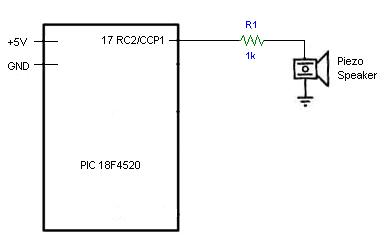
It's not a buzzer, it's just a transducer. And like I say, FREQOUT (according to manual) is limited at 4mhz and would like to know more.
Ok -- good link -- I'll try the PWM command instead.
I seem to recall the FREQOUT command is only accurate at 4 MHz. If you're clocking at 8 MHz, divide the value by 2 (and so forth). The command itself should work at any clock speed. Just take into account any divisor needed to achieve your 6500 Hz.
If you have Mister E PIC Multi-Calc, you can use the Timer Helper to create any frequency the processor is capable of, and at any chosen Fosc.
From the manual:For simple beep type of tone from a piezo buzzer just use PWM, HPWM or "manually" run the (E)CCP module.FREQOUT works best with a 20MHz or 40MHz oscillator. It can also work with a
10MHz or 8MHz oscillator and even at 4MHz, although it will start to get very hard
to filter and be of fairly low amplitude. Any other frequency will cause FREQOUT to
generate a frequency that is a ratio of the actual oscillator used and 20MHz.
/Henrik.
FREQOUT can do dual frequency (polyphonic), and that is a mess at 4MHz.
DTMF works the same way, but I’ve never had a telephony system understand it for a pic clocked less than 20MHz, no matter what I do.
For a single frequency it might be ok, but as said, PWM is non-blocking, can make the sound forever, and a much better choice for a single audio freq.
I may have to use PWM as it appears FREQOUT won't function with my antique 16C72. (I have a boatload of them).
The 16C72 is 8bit.
We'll see -- thanks -- will get back to you no doubt.
Also using a 2N4401 to drive the piezo, would imagine I need it ?
I wouldn’t say “need”.
You’d get best results using any of the shrouded ones that will at least be loud at their resonant freq. That would be money better spent than on the transistor I think.
The pic could probably drive a small speaker through a series capacitor. I used a MAX232 as a buffer for a speaker, and small output transformer (MAX232 drives the audio positive and negative).
Bookmarks