Hi Fredrick,
I don't see any issues with that. After all, differential signaling over long cables is what those chips are intended for, the RS485 standard specifies 1200m.
You'll need decoupling caps though but I'm sure you know that.
/Henrik.
Hi Fredrick,
I don't see any issues with that. After all, differential signaling over long cables is what those chips are intended for, the RS485 standard specifies 1200m.
You'll need decoupling caps though but I'm sure you know that.
/Henrik.
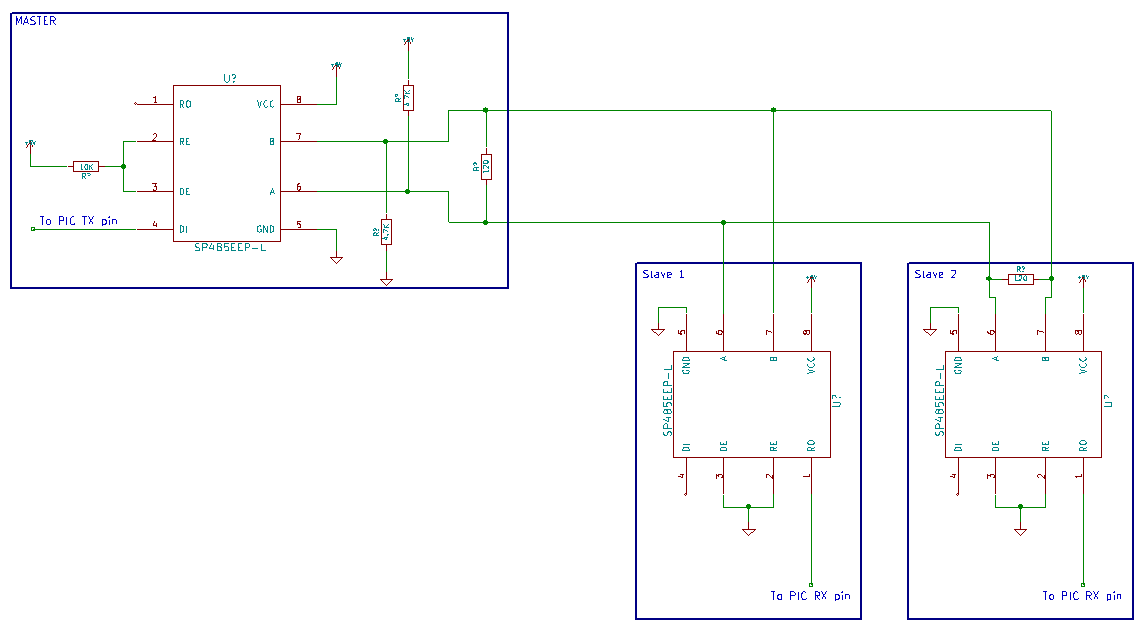
If you're going to permanently enable the transmitter on your master you can get rid of the pullup/pulldown resistors and just have the termination resistor.
The pullup/down are there to bias the state of the line when you disable the transmitter so that the lines are seen as an idle state.
The optimum cable for RS-485 communication is of course a dedicated RS-485 cable, but I have read that a CAT5e is also working well and are very inexpensive, but how will a 3x0.75 untwisted cable work in my case, and why will it work or not work?
tumbleweed:
Yes the transmitter will permanently be enable at the master, Thank you for the information.
Henrik:
Yes, If you mean the decoupling caps between VCC and VSS on the transceiver chips.
A twisted pair works better as the impedance is more controlled along the wire vs having them in a bundle. Also, it helps with noise immunity as any induced noise signals are fairly equal (or common) in both conductors and are cancelled out by the differential receiver. All of that helps with long distance communications.
It's probably hard to beat the cost/availability of network cabling these days. While it's not "RS-485", many use it and it works fine.
For a test-setup I did I used some cheap 4-wire single strand telephone wire. 4 slaves with 30 metres of cable between each (90m total) it worked fine but it was "only" 90m and in a relatively "quite" office environment. For a real-life setup I'd use twisted pair cable, any old twisted pair cable will most likely work just fine but, like tumbleweed says, CAT5 or whatever is probably hard to beat in price and accessabillity.
I believe CAT5 cable is has a specified impedence of ~100ohm while for RS485 it ideally should be 120ohm. If you're not running super high bit rates, close to the maximum speed of the tranceivers I don't think it'll matter much.
Since you're working at such a low baud rate (2400), you might be better off picking a transceiver that's slower.
The SP485 is rated for 10Mb operation. You can get RS485 drivers that work at much lower speeds, like 250K baud.
The lower speed chips have slower slew rates on the signal edges so things don't change as fast, and that will help with any cable mismatch (the slower the edges the less things look like a transmission line). You'll also get much less EMI. Plus, they're usually cheaper.
Why not consider ISO-9141 single wire half duplex at that slow baud rate.
Dave Purola,
N8NTA
EN82fn
Bookmarks