Henrik,
While the professional is working up the best scheme.
Question..... on the last itteration to stopping, can you subtract 'position now' from 'position desired' ?
and if so, can you move exact steps of the difference with the A value?
Don
Henrik,
While the professional is working up the best scheme.
Question..... on the last itteration to stopping, can you subtract 'position now' from 'position desired' ?
and if so, can you move exact steps of the difference with the A value?
Don
Hi Don,
If it always ends up short of the actual target AND the remaining distance TO the actual target is always less than A_Max then I could probably live with that. It means that it would always reach the actual target within a single "tick" from optimal.
However, I'd have to move it a speed equal to the actual distance to target, if moved at A_Max then it would overshoot in one tick - which in turn gives it a little bit of "S" at the end reducing the jerk. Might actually be good.
Thanks!
/Henrik.
Surely I will say something obvious, but since I did not noticed it in the above post, let me say it.
When the travel distance is less than twice the accelleration the trapezoidal profile become triangular and V max decrease, so that Vmax = tan(accelleration Slope) time the travel distance / 2
Cheers
Al.
All progress began with an idea
Here's what I'm up against ...
You can only adjust the acceleration.
I don't see any way to know what acceleration is required to make the half-way point end up exactly at an interrupt period.
It always ends up somewhere in the middle of a period.
If I new what the velocity would be at the halfway point, I could adjust the acceleration so it reaches the half-way point at exactly an interrupt period.
Except that since the acceleration changed, it won't be at that velocity at the half-way point anymore.
So I don't see any way of predicting the half-way point in order to use the same deceleration slope it uses for acceleration (the yellow line).
I can only change the acceleration at specific times, which coincide with the interrupt periods.
So if I recalculate the deceleration slope at period 6 before it reaches the half-way point, it creates the green line, which should end up at the target perfectly.
If I were to recalculate it after passing the half-way point, the deceleration rate would be higher, and violate the A_Max constraint.
The blue line is the overshooting profile, with it's velocity using the left axis.
The red line is the position, using the right axis.
The parameters for that run were ... A_Max=10, V_Max=100, Target=475.
I'm doing the green line.
But since the green line is actually a slower velocity, it will take longer than shown in the chart to reach the target.
But at least it is calculatable.
DT
Realistically, there will be thousands of intervals, the error will be tiny. We use an interval of 2mS and get a QC count of 1 at 15 RPM to 680 at 10,000 RPM. (using a 512 line encoded motor)
I would suggest to leave the acceleration at the demand rate, and work out when to stop accelerating and run at a constant speed or to decelerate in time to hit the target.
Timmers,
You are talking about the control that Henrik is using. I'm sure the intervals are much smaller, and it includes a PID loop with an encoder feedback.
My task is to generate a "Profile" for that control to follow. A much different situation.
DT
Henrik,
I think i have it all working now.
It's really ugly and needs to be cleaned up.
But before I do that tomorrow, I have one last question.
Would adding an "Ease From" and "Ease To" function to the beginning and end of the profile suffice for the 3rd order curve thought?
DT
Hi guys,
First of all, for clarity:
The PID-loop is already in place. It servos the motor to the position given to it and does whatever it can to bring the motor to the commanded based P,I,D and feedforward parameters. If the error between the target position and actual position gets above a setable limit the loop faults and aborts. This is one of the reasons for needing the profile generator - I can't just ask the PID-loop to move the motor 10000 QCs (quadrature counts or steps or pulses or units or whatever we want to call it) because if I do an error of an equal amount (10000) will instantly develop and the loop will fault. Even if such large errors was allowed the resulting move would be less then optimal.
The profile generators job, being discussed here, is to generate input TO the PID-loop which the motor and load is actually capable of following.
The input to the profile generator can then be "stepped" 10000 QCs. It then will generate a velocity profile with the parameters given to it. Each "tick" the profile generator will give the PID-loop a new position for it to move the motor to during the next time interval. The PID-loop is executed between 500 and 2500 times per second and so will the profile generator. At least that's the idea.
Darrel,
Although I'm having some difficulties figuring out what the worst case scenario could be with the "green line approach" I don't think doing it that way should be any problem in real life. It's better to "stretch" the deceleration phase than to violate A_Max although I would prefer it symetrical but I get what you're saying - I think.
Thanks!
/Henrik.
Darrel,
Missed your last post while composing mine.
You mean like a initial "step" (or steps) at a velocity less than A_Max, just to "break the edge" on the trapetzoidal/triangular profile? (If not, could you clarify?)
That could help, ideally it should be at all four "corners" of the profile but having it at the start and end of the move is certainly better than nothing.
Thanks again Darrel!
/Henrik.
I found this article on setting and using the qei /pcpwm modules and incorporated it into my scheme ,its worth a look the qei.h and motor_pwm.h in particular.
http://hades.mech.northwestern.edu/i...l_Port_Example
It is all relative to time. One thing not concidered yet is what to do if the servo has not achieved the demand. Do you run the servo faster/slower (velocity), harder/softer rate of change (acceleration & deceleration), longer/shorter (time) or forwards/back (position) to achieve the end target?
I assume you are attempting to modulate the velocity to achieve an end target at xx time whilst keeping the rate of change and max velocity within the set limits.
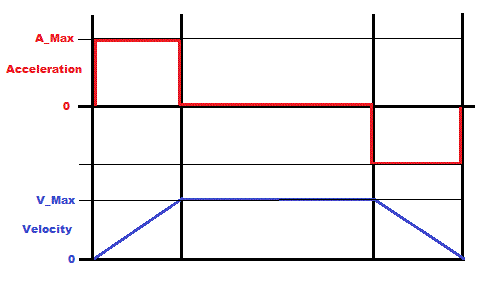
If you concider a velocity/time graph (trapezoid shape), with velocity as the height of the perpendicular at the current time, then the distance to travel is the area under the graph from the current position. (see graph in post #1)
The math to extract the velocity demand (in QC's / time period), at any given time, according to end target, defined limitations and servo error, is what you are trying to calculate.
Am I helping?
this works on the real servo motor. what a difference the qei module makes ,and 14 bit pwm seems much smoother
pid rate now 1ms ramp rate 8ms with 49 steps , no attempt yet to handle short moves but long ones are good . fwd and backwards moves are good .
pos counter 24bit / vmax and accel are fixed constants so far
Hi Richard,
I've actually made some progress myself too, just for fun I'm attaching a photo of my little testbed. It was designed a long time ago, at the time I was Little "afraid" of the PCPWM module so it's actually using the normal CCP module for the PWM output, 19.531kHz, 10bit resolution. What PWM frequency are you using to get 14bit with the PCPWM module?
Anyway, my code seems to work pretty good in the real world too. PID-rate is 1220Hz (derived from the PWM time base, 1:16 postscale). Initially I tried to run the profile generator "slower" than the PID but it really didn't want to fly properly. Now it's updating at the same rate as the PID and it's working pretty good. The CPU load is pretty high during deceleration but I'm "only" running it at 20MHz on this board so at 40MHz it'll be more relaxed. Acceleration, velocity and distance can be set arbitrarily.
Time is limited and motivation to work on it comes and go but I'll keep poking at it.
/Henrik.
yes noise is an issue for 14 bit its 1.8khz , much quieter at 16khz and 10 bit res fosc is 32mhz (8meg rock *4pll)
I need to make a better test bed 600ma from the l293d is a bit limiting .
got the pid routine under 500us worst case using floats . I find that floats are easier to work with (mentally) for experimenting with but will go back to ints when I have things sussed out.
I'm not sure how I will go about implementing variable velocity or accel yet. I was just really happy to get " pid lock " and good position control to start with.
ps using the microchip c floating point library adds 8k bytes to the pgm its huge
Last edited by richard; - 18th October 2014 at 15:52.
the idea was easier to implement than I expected. when the setpoint to target distance is less than the ramp_length + the constant velocity increment , rather than any fancy math I just set the setpoint to the target-ramp_length value. I just let the pid work the mechanics out for its self. after that its just a matter or playing the array back backwards to arrive dead on target .
I have included a poorly annotated sketch of my c routine,
the motor I want to use can only achieve 300 counts/sec (accel 2000 counts /s/s) and needs to not have a count for at least 30mS to guarantee 0 vel , therefore the pid loop is run @40mS intervals and the profile input is applied on every second pid loop. this works pretty well (motor inertia gives smooth motion) and it stops on target _+ 1 count (pid might need better tuning).
seems to me that motor/load characteristics really change the entire nature of the problem.
I'm yet to try this on a real servo motor my pid loops are taking 50-300 uS to run so hopefully a 1mS pid rate is possible , I think I will get some pic18f2431's and have a play with thev qei module
I forgot to add that in my application the accel and max v will never change only the direction and distance therefore the ramp array will never need recalculating , for "short" moves i just reduce the number of elements played out. the pid tolerance seems pretty accommodating.
I want no overshoot no stalling and no hunting +- 4 counts is accurate enough . its controlling the really stiff and jerky air slide on the pid controlled wood heater in the lounge (its a matter of principle)
Bookmarks