It doesn't say if it should be inverted or true mode.
I did try [hex bright,0] and other permutations, like sending the Ascii value "z" instead.
I finally put a scope on it and tried to relate the command to the scope trace. This is what I got for $7A (brightness control, Ascii "z")
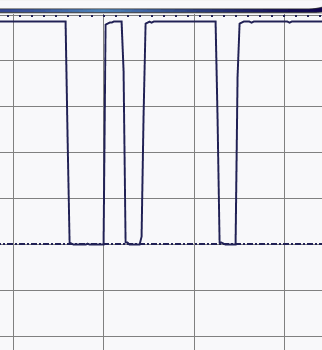
When I write the binary version out, it is indeed $7A or %0111 1010, except it's back to front. What I would have expected to be the msb at the front end of the trace, is at the back end. In other words, what is being sent is not $7A, but %0101 1110. (At least when I used to demonstrate RS-232 signals, they used to follow that convention). Tell me if I'm wrong.
So, what do you guys figure is happening? Maybe the inverted/true mode business? How do I choose either mode? I was looking at the REV command to reverse all the bits, but that seems rather "kludgy".
The latest code:
Code:
DEFINE OSC 4
DEFINE HSER_RCSTA 80h ' Enable serial port (b7=1 to enable TX as serial port pins
DEFINE HSER_TXSTA 24h ' Enable transmit, BRGH = 1
define HSER_BAUD 9600
'DEFINE HSER_SPBRG 25  ' 9600 Baud @ 4MHz, 0.16%
DEFINE HSER_CLROERR 1 ' Clear overflow automatically
trisc.6=0
LED var portc.6
'****The following are the control codes for the Sparkfun serial 7-segment display
decpts con $77   ' "w"
bright con $7A   ' "z"
setbaud con $7F '2=9600, 4=19200
reset   con $76  ' "v"
lsb     con $7B  ' "{"
dig2    con $7C  ' "|"
dig3    con $7D  ' "}"
msb     con $7E  ' "~"


'hserout [setbaud,2]
Main:
HSEROUT [bright, $ff]
       pause 50
goto main


 hserout and serial 7 segment display


 Originally Posted by queenidog


Bookmarks