If you do not believe in MAGIC, Consider how currency has value simply by printing it, and is then traded for real assets.
.
Gold is the money of kings, silver is the money of gentlemen, barter is the money of peasants - but debt is the money of slaves
.
There simply is no "Happy Spam" If you do it you will disappear from this forum.
Is that a rectifier diode in the plugpack power supply ?
Hey mtripoli,
How would you like to make a PCB for this:
Give me a bit and I'll whip up a schematic with the transistors the wrong way round
Nah just kidding
I'm not actually using the 7805s at the moment because I have a 2 amp 5 Volt regulated wall supply.
The plugpack is a charger for a Sony PSP, and I would have thought the caps would be in that.
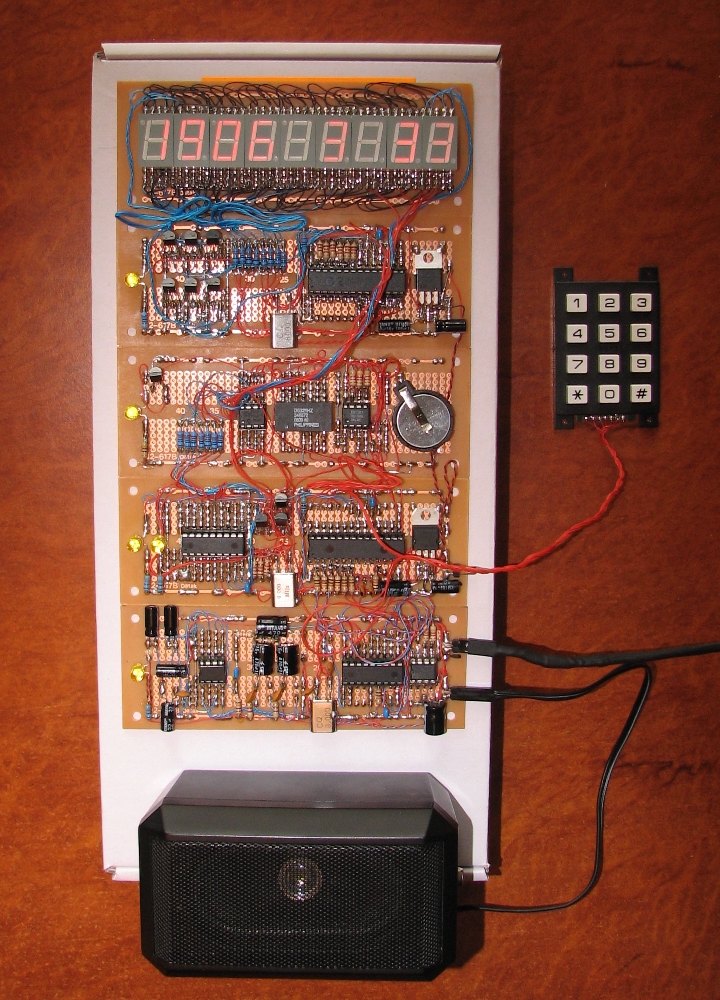
So it's a talking clock with a display now, but I also want to add an FM radio that I'm making with a Philips FM radio IC tonight.
There should be some circuit to switch the input of the amplifier chip
between the pic and the radio chip.
Should I use signal transistors?
Last edited by Art; - 3rd March 2010 at 10:38.
I don't know what the output of PSP supply looks like. I have never seen what a "plug-pack" (what we derisively call a wall-wart) looks like for the PSP. I would be very surprised if it has any kind of filtering at all. Usually these things are a transformer, a bridge (if you're lucky) and MAYBE a single cap (it could be a universal input switching supply as well. If so the thing most likely has tons of high frequency component on the DC. Some ceramic caps strategically placed may be all you need. LM78xx devices don't respond at these higher frequencies and will let a lot of this through). The manufacturer places the caps and related circuitry in the device being powered (for lots of reasons). So first, whenever you are using a "plugpack" put some big caps on the input of the supply to the board. 470uF-1000uF is not unusual. Use some ceramics as well. Watch the voltage; don't use a 6.3V cap on a "5V" supply (higher voltage never hurts). Typically voltage rating is under load, so a "5V" supply may actually be much higher than that.
Mike Tripoli
hmmm.... using a wall wart for power.....
Many "modern" wall warts now contain switching supplies instead of the traditional xformer/rectifier setup in order to meet minimum efficiency standards
that now apply in many areas.
That may well be the source of your noise. Like Mike said... an electrolytic cap of a few hundred uF, with 1 or more small (.01-.1uF) ceramic caps in parallel may help a lot.
steve
Thanks Guys,
a 1000uF cap across the supply almost eliminates the noise
That's a bit big, but I'm sure I'll find a combination that works well.
I just mean a bit big looking on the circuit,
and it might prevent PCB stacking with tight spacing (if I go that way).
I'd rather use a couple of smaller ones.
This one is to end up a talking clock radio.
At last, a project I actually use in day to day life![]()
Bookmarks